In the ever-pulsating center of the digital cosmos, networking experts serve as the invisible architects and problem solvers, ensuring our interconnected world functions properly through the exchange of data in milliseconds. However, here’s the best news about it: for anyone eager to become a professional in this area, you do not have to have years of work experience in companies to become one.
Novices with enthusiasm and proper knowledge, documentation, and demonstration are already securing positions as network engineers through their capability to configure, secure, and maintain networks from scratch.
Do you find yourself looking at your CV and wondering how to make it stand out when you have networking knowledge but little or no professional experience?
Then this article will be just what you are looking for. In this piece, we will teach you how to translate your experience of learning into something that recruiters and ATS cannot overlook.

Choosing Your Target: Where Do You Want to Plug In?
Success starts with direction. Even before getting into commands and wiring, figure out your best port to connect yourself. Some popular entry points may be:
- Network Support Engineer
- NOC Engineer
- IT Support Engineer
- Junior Network Engineer
- Network Technician
Research through hundreds of job openings available. Find out the common skills and keywords used there. Such an investigation makes sure that whatever skill you master and whatever projects you undertake are fully aligned with what the companies demand. Your resume targeting network engineer jobs for freshers will be speaking the language of the companies.
Mastering the Core: Essential IT Networking Skills That Matter
Networking basics can be considered as the DNA of each modern infrastructure. You learn these, and you get an unbeatable foundation that will impress every networking skills resume listing:
- Models OSI and TCP/IP – the universal map of how the data goes
- IPv4 addressing and advanced subnetting – to speak the native language of networks
- VLANs, trunking, and inter-VLAN routing – to create an efficient, segmented network environment
- STP, EtherChannel – to create a redundant network without chaos
- Static routing and OSPF – to direct traffic effectively
- DHCP, DNS, NAT, and ACLs – to deliver the services and impose the rules
- Basic network security and hardening methods
- Systemic approach to troubleshooting
Don’t just read about these. Learn actively. Sketch the diagrams, discuss theories aloud, make examples of their practical implementation. This will make you a student who has become a junior engineer.
Practice the concepts you’ve learned during your IT networking training, depending on the course or technologies you have studied—such as CCNA, CCNP Enterprise, CCNP Security, CCIE Enterprise, CCIE Security, or firewall technologies like Palo Alto and FortiGate.
Hands-On Mastery: Building Real Experience in Your Own Lab

This is where the magic takes place – the interaction between the theory and practice. This is how you can make the best use of Cisco Packet Tracer:
- Create increasingly more complicated network topologies
- Get familiar with Cisco IOS commands by practising repeatedly
- Configure your routers and switches starting from basics and moving on to the more complicated aspects
- Deliberately create errors and learn how to fix them
- Use Wireshark to capture, analyse, and interpret your packet conversations
- Take detailed lab notes: configurations, screenshots, topologies, “war stories” about fixed problems
Not only that, but you’re creating your own portfolio in the process. Each fixed problem means that you’re gaining your troubleshooting skills – the most precious asset for any networking job position.
Project Power: Your Resume’s Secret Weapon

Projects will make you shine above candidates with conventional experience. They show initiative, problem-solving, and technical implementation abilities. Highlight your best projects on your resume few examples for your reference:
| 1. Segmented Office Network Using VLANs and Inter-VLAN Routing | Objective: Develop a network to link different departments with restricted access. Tools: VLANs, 802.1Q Trunking, Layer 3 routing. Outcome: Departments can communicate securely and efficiently. |
| 2. Multi-site OSPF Dynamic Routing | Objective: Automate routing processes and enhance redundancy. Tools: OSPF areas, IP subnetting, Route Summarization. Outcome: Complete connectivity with fast convergence. |
| 3. Automatic IP Configuration with DHCP and NAT | Objective: Simulate an internet connection like an ISP. Tools: DHCP server/relay, Port Address Translation. Outcome: Devices automatically configure themselves. |
| 4. Secure Hardened Network | Objective: To deploy access controls and security from afar. Tools: EACL, SSH, port security, and password policy. Outcome: A secure environment immune to standard attacks. |
| 5. Redundant Network Design | Objective: Single point of failure should be avoided. Tools: STP/RSTP, EtherChannel (LACP). Outcome: Fault-tolerant network which will not go down when links fail. |
Crafting a Professional Resume Structure That Stands Out
Create a resume format that is well-connected and efficient, like a network.
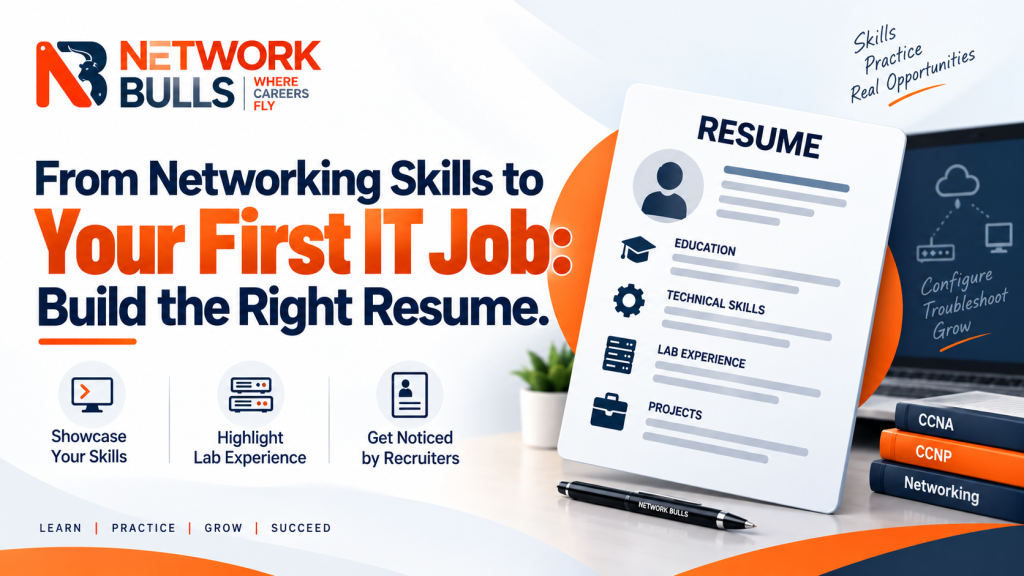
- Contact Information – Email, mobile phone number, LinkedIn account, physical address
- Professional Summary – A strong 3-4 sentence summary of your skills in networking, strengths, and professional objective
- Technical Skills – Classified and keyword-heavy
- Certifications – Start with CCNA or the likes
- Networking Projects – Descriptive and results-driven (must be up front! )
- Education-Degrees, institutions, relevant coursework.
- Transferable Skills – Communication, teamwork, analytical skills
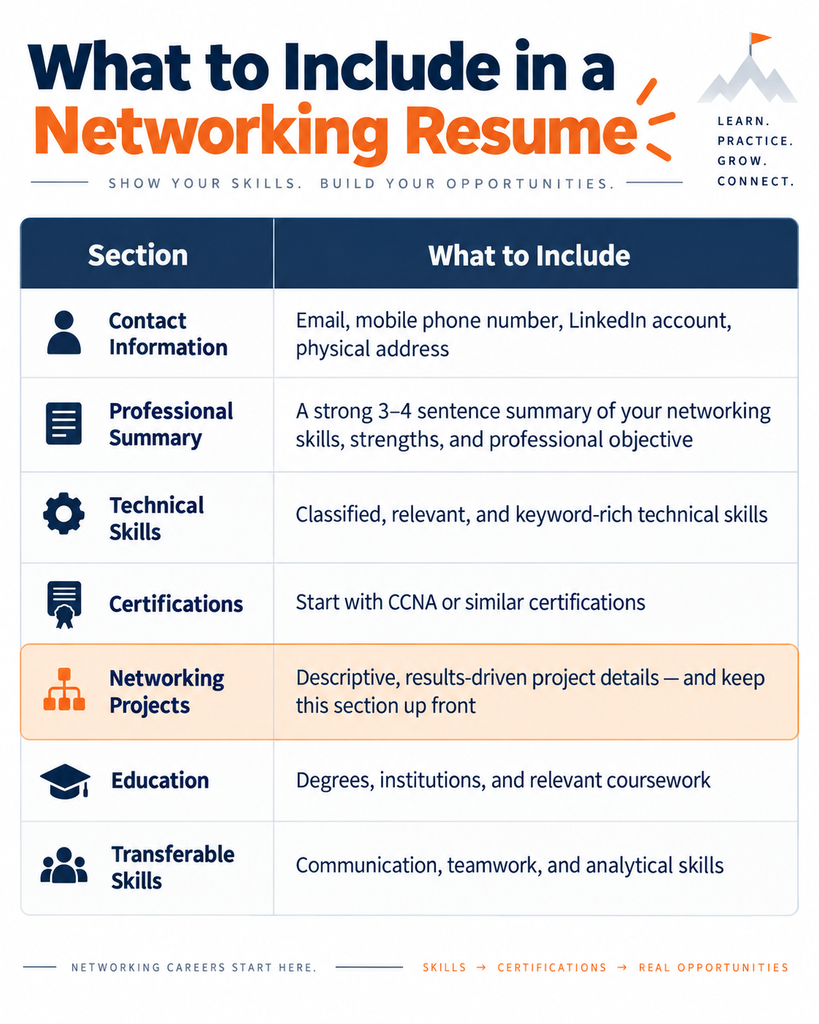
The aforementioned resume structure places your best qualities in the forefront of your entry-level network engineer resume.
ATS Optimisation: Getting Past the Digital Gatekeepers
ATS resumes cannot be avoided. Make the most of them using these tested strategies:
- Adhere to a clean, single-column format
- Use traditional fonts and plenty of white space
- Include relevant keywords organically drawn from job descriptions
- Avoid graphics, tables, columns, and advanced formatting
- Keep it concise to one page
- Tailor it for every submission
- Be honest about what you know – never fabricate experience
With an ATS-optimized networking resume that lacks experience, you ensure that all your efforts go towards reaching real-life recruiters who understand your abilities.
Your Career Roadmap: From Beginner to Network Rockstar
Adhere to the following roadmap for guaranteed success in the field:
- Familiarize yourself with basics
- Lab-intensive work experience
- Undertake significant projects
- Pass the CCNA test
- Develop and fine-tune your CV
- Improve on your interviewing techniques
- Job applications with confidence and persistence
Once you have laid the foundation with CCNA, go ahead and explore the fields of CCNP Enterprise, security, firewalls, AWS networking, SD-WAN, and network automation in Python and Ansible.
Accelerating Your Success with Network Bulls
While self-studying helps, a well-designed program can save you years of trial and error efforts and help you learn faster. Network Bulls is particularly adept at providing job-focused networking courses along with job guarantees for hardworking freshers.
Network Bulls’ courses include:
- Detailed CCNA training with placement and advanced levels of CCNP and CCIE
- Hands-on practice with routers, switches, and firewalls
- Troubleshooting
- Modules on security, cloud computing, and other cutting-edge technologies
- Interview preparation
- Dedicated placement services
You can choose from specialized courses like Enterprise Networking, Network Security, Cybersecurity, and Cloud Security depending on your needs. The Network Bulls job guarantee program offers you an entire ecosystem right from learning to getting placed in your first job.
Eligibility and conditions for job guarantee and placements are subject to program terms and conditions.

Conclusion
The digital age requires more competent networkers than ever before, and success favors those who prove their competence through actual ability rather than mere experience. With a solid understanding of essential concepts, excellent projects and certifications, and proper presentation of all of the above, you can make your networking resume without experience working for you.
Forget asking how to get a networking job without experience, and start proving your worth by documenting your labs and displaying your projects.
Eager to expedite your learning curve? Try out Network Bulls’ hands-on, job-oriented networking training programs today. Your entry into the networking world starts now.
Learn. Prove. Make your resume work for you. The network is waiting — answer the call!
Frequently Asked Questions:
Highlight certifications, technical skills, elaborate lab projects, and troubleshooting stories. Highlight what you do rather than the job titles.
Focus on OSI/TCP-IP, subnetting, VLANs, routing protocols, DHCP/NAT/ACLS, security fundamentals and others (Packet Tracer, Wireshark, etc.)
Of course. Illustrate them as professional projects with specific aims, configurations and results.
VLAN-segmented networks, OSPF topologies, DHCP/NAT environments, ACL-secured environments, redundant (STP/EtherChannel) design.
Practising through Packet tracer labs, writing commands, and analysing packets using Wireshark, as well as proper documentation to record all steps and changes.
Go for simple layout, use the default fonts like Times New Roman or Arial, insert industry specific keywords into different sections of your CV without altering the meaning of the context, avoid adding graphics and limit your resume to one single A4 page.
There are job opportunities such as Network Operations (support), Network Operation Center (NOC), Junior Network Engineer, IT Support, and Network Technician positions.