
Gaps Don’t Define Careers. Comebacks Do!
The day of graduation marks the beginning of your journey. You march across the stage holding your degree in hand and expecting a perfect transition ahead – job offers, an excellent laptop and entry into the world of coding, clouds and system administration. However, soon enough reality strikes. Months pass.
Applications are ignored; interviews do not proceed further. All of a sudden, you find yourself looking at the calendar where there is a 6-month, a year, or more gap. Fear starts setting in. “How am I going to explain this? Are recruiters going to discount me?”
This is relatable for many students who face the situation of a career gap after their graduation from college. It happens more often than you think. Market slumps, delays in recruiting cycles, personal or health reasons, family commitments, or simply the period when you figure out your next step can cause a gap after the completion of your studies. But remember one thing – gaps in your career do not determine your capabilities.
This is a guide tailored precisely for graduates with gaps of 6 months, 1 year, or more. Learn how to justify those gaps without excuses, gain momentum back and prove to be an outstanding candidate for the new opportunity.
Why Career Gaps Happen After Graduation in IT
IT is full of challenges and uncertainties. There are many factors that might cause career gaps after graduation at once for fresh graduates. Placements on campus are no longer available. Companies are on hold in terms of recruitment. One might have chosen to aim for a specific position that was not suitable for a beginner. Some personal circumstances like moving, family problems, depression, financial issues, etc. might become a reason too.
A 6-month gap is caused either by a longer job search or short courses.
A 1-year gap might include additional learning, an internship, and even health issues. Longer gaps could be associated with several attempts, entrepreneurial ideas or some other life changes.
In any case, a career gap does not necessarily mean that one is a failure. Recruiters in IT positions are used to seeing gaps. The most important thing is to show progress and interest in development.
A career gap is not a sign of failure—it’s a pause in your journey, not the end of your potential.
The Real Cost of Staying Silent About Your Gap
Some graduates attempt to cover up the gap through date stretching, not mentioning the months involved, or outright avoiding the subject matter. This tactic seldom helps and often results in discrepancies that become obvious in background checks and interviews. What’s more, all the efforts spent trying to hide something become apparent as noticeable nervousness. Once the question “what have you been up to after graduation?” pops up, all your confidence disappears.
The other option is equally effective: make the gap yours, spin a story around it, and use it to prove your resilience. By explaining your gap in a clear and proactive way, you show self-awareness, a rare quality for collaborative technology teams.
How to Explain a Career Gap Confidently
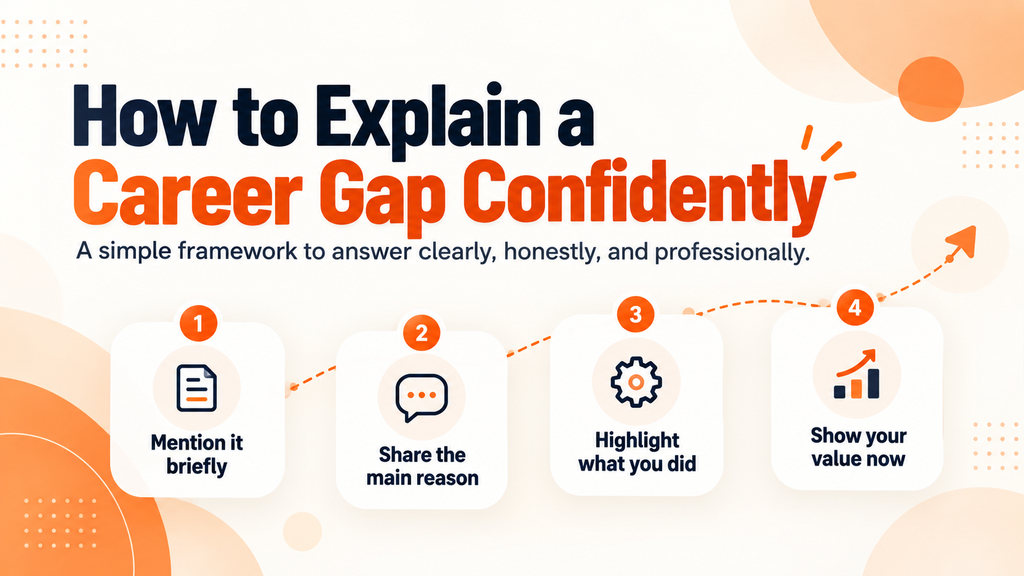
The core of a good explanation lies in truth and intention. Stick to this basic framework whenever you explain the gap, in your CV, on LinkedIn, in your cover letter, or during interviews:
- Mention the gap factually and briefly.
- Give the main reason without going into unnecessary details.
- Mention something productive you did during the gap period.
- Shift to how you add value now immediately.
Check out the scripts below depending on the length of your gap for mentioning the duration of the gap.
| Duration | Sample Script for Resume/Interview |
|---|---|
| For a gap duration – 6 Months: | “After graduation in [Month/Year], I spent the next six months honing my practical skills through relevant projects and certifications. It was hard to find a job due to the tough job market, but I wanted to make sure that I would be able to make a contribution from day one. In this period, I managed to complete [name of project], got certified in [name of certification], and gained a better understanding of [name of tech stack]. |
| For a 1-year gap: | “After graduating from college, I took a year off to create a link between the theoretical knowledge and practical requirements of the corporate world by doing [a boot camp], contributing to open source projects, taking up freelancing projects, and making connections in the tech circles around me. Through the process, I learned [a lesson—in terms of discipline, prioritization, debugging]. I now feel better prepared and more focused.” |
| For longer gaps (18 months or more): | “The path I took after graduating from college was [quick note about what I did] and in the process I stayed updated in the field of technology through continuous learning, working on projects for myself and as an adviser and consultant in the field occasionally. It gave me [problem-solving mindset, perseverance, maturity, etc.] along with the technical preparation.” |
Notice how there is a short explanation, some constructive thing you did during that period, and then you move ahead with your statement. Practice them aloud and record yourself.
Strengthen Your Story With Evidence
Words won’t do it alone. Get some evidence to back up your story. During each gap, use every month as an opportunity to gather:
| GitHub accounts with well-kept commit logs and README files. | Projects or demos that have been deployed. |
| Articles on blogs or LinkedIn describing what you learned. | Open source or community contributions. |
| Proof of learning on platforms such as Coursera, AWS, Google, or Microsoft, and preferably with in-demand skills. | Freelancing or voluntary work using technical skills. |
This makes for points of discussion that will move the focus from “why is there a gap?” to “tell me about this project.”
Practical Steps to Restart Your IT Career
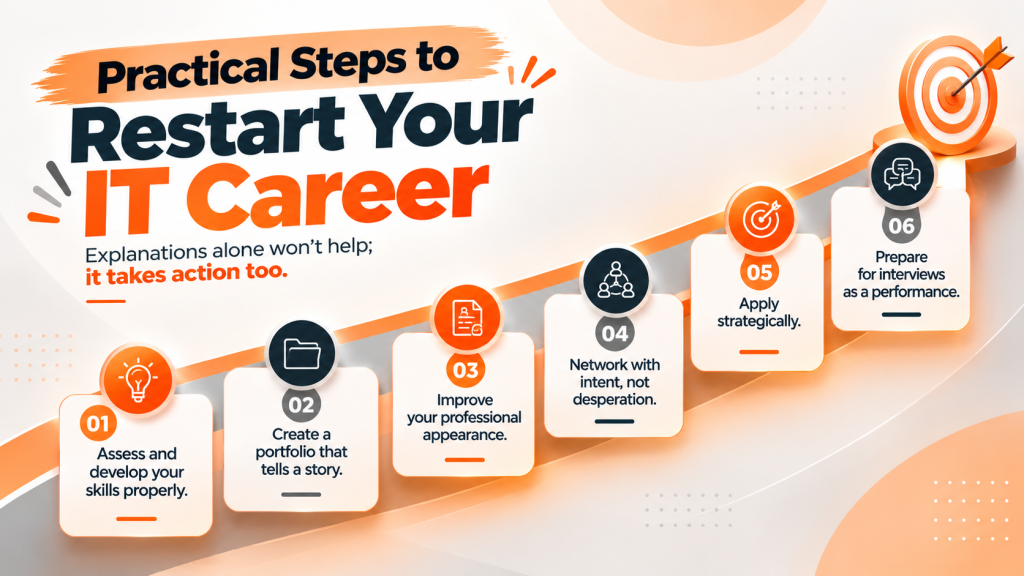
Explanations alone will not cut it; it takes action too.
1. Assess and develop your skills properly.
Discover the most needed skill sets for entry and junior positions in your field of interest — whether web development, cloud, data, cybersecurity or DevOps. Prioritize the gaps, fill them by learning rather than taking any courses aimlessly. Set yourself a specific time each week for this task. Record your progress publicly.
2. Create a portfolio that tells a story.
Three to five well-developed projects outweigh twenty unfinished ones. Solve interesting tasks from the beginning to the end and explain your choices. Write about challenges you had to face and how you dealt with them. It will prove to be exactly the type of thinking that employers require.
3. Improve your professional appearance.
Your LinkedIn profile headline and About sections should now reflect your preparedness level and not your graduation year. Your LinkedIn summary must include a constructive explanation of your gap period. Make your CV chronological, but add a brief section named either Professional Development or Independent Projects that covers your gap period.
4. Network with intent, not desperation.
Connect with alumni, join virtual networking events, participate meaningfully in appropriate Discord and Slack channels, and ask for informational interviews. When asked about your gap, use the story you have prepared and ask insightful questions of your contact. Networking is most effective when it’s based on genuine interest.
5. Apply strategically.
Apply to positions that are 70 per cent of a match with your skills, instead of waiting for the perfect fit. Personalize each application and monitor its progress. Don’t shy away from contract, intern-to-hire, and even small company positions if the large companies keep taking their time.
6. Prepare for interviews as a performance.
Prepare for the gap interview question and answer it within 45-60 seconds by utilising the structure above, before shifting the conversation to your projects or subject matter expertise. Prepare behavioural interview questions that showcase adaptability and continuous learning through collaboration.
Mindset Shifts That Make Restarting Easier
Gaps can seem like lost time. Try to reframe this idea. Time spent becoming resilient, gaining clarity around career goals, or regaining personal bandwidth is never wasted. Some highly successful IT professionals follow non-linear trajectories.
Problem-solving and constantly developing oneself is what the industry favours more than adhering to some ideal timeline.
Take care of your energy levels.
Do not compare yourself too much on social media. Take pride in small victories—completing something, receiving good feedback on pull requests, getting into interviews. It takes less time for consistency to build momentum than intensity followed by burnout.
Common Pitfalls to Avoid
Do not apologize all the time. Do not make up unnecessary stories. Do not say that you “travelled the world” when you didn’t. Do not stop learning after starting applications, and do not take it personally that each rejection is about the gap.
A career gap doesn’t mean the end of your professional journey! Discover how Network Bulls students overcame career gaps, chose IT Networking, developed practical skills, and successfully restarted their careers.
Watch their inspiring journeys and placement success stories:
Conclusion
Graduating and not working immediately afterwards does not make anyone an outcast. It is just another part of the story, and a very strong one once you figure out how you want to tell it. It doesn’t matter how long your gap is, as your honesty, clear skills, and action will open new doors in the IT field.
Do it right now. Find a project that you would like to complete, an explanation to practice, and a resume to send. The market changes, technology develops, and the companies are still in need of people who are able to learn, adapt, and accomplish things. You already have the background your degree provides. All you need to add is proof of development during the period of your gap.
That’s where your new beginning starts, to see the gap as your experience instead of a disadvantage. There is enough space in the industry for your unique story. Now go tell it confidently.
Check 100% Job Guarantee Courses
- CCIE Enterprise Infrastructure V1.0/R&S Training in India
- CCIE Security V6.1 Course
- Cyber Security & Network Security Course
- Cloud Security + Network Security Expert
FAQs
Answer in under a minute. Explain the gap as a fact, list one or two productive things you did (project work, training, certification, open source) and quickly shift focus to the skills you have gained from it and how ready you are for the position.
Not necessarily. It would not be a major drawback if you were able to prove to the interviewer that you were still gaining knowledge during this period through projects, etc.
Include a separate section titled “Independent Projects & Professional Development” where you indicate the technologies you used, completed projects, and certifications achieved during this period. Be truthful regarding your employment history, providing it chronologically. It is better to show activity and provide evidence rather than attempt to hide the truth.
Choose in-demand technologies related to junior positions, go through the courses and get certification, build projects, publish them on Github, network. Several months of regular activity will often outweigh the career gap.
Stay professional and brief. You may mention categories such as family obligations, recovery from illness, or skill development, but not your personal issues. The main goal of the recruiters is to make sure you have settled all your issues and are fully engaged.