Tell me about yourself.” For IT freshers, these words might be surprisingly hard to answer.
You might already know about your technical skills and may have completed certifications and started preparing for your interview, but when the recruiter poses this question to you, then at that time you may feel confused about where to begin, what you should talk about yourself and how you should begin with your education, skills, projects, hobbies, or your career objectives.
And the best news is that the question “Tell me about yourself” is not at all a tricky one. Instead, this is your chance to take the initiative in the first minutes of your interview and make a great first impression.
For freshers who apply for positions like network engineer, software developer, cybersecurity analyst, cloud engineer, IT support engineer, system administrator, or technical support executive, a well-structured self-introduction might help a recruiter understand your background, technical skills, and career path.
In this blog post, we will discuss how to answer “Tell me about yourself” for IT freshers, what recruiters expect, examples to use, and what not to do.
Why Do Interviewers Ask “Tell Me About Yourself”?
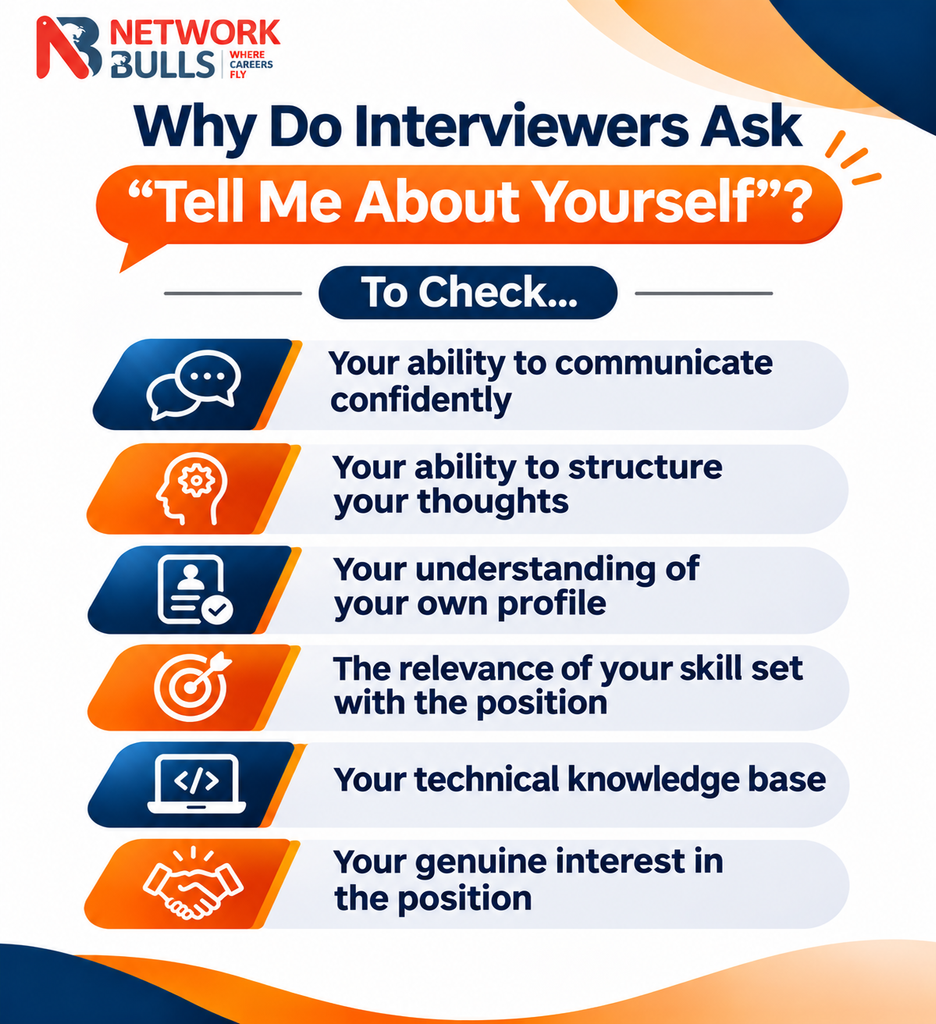
To answer this question, one must first be aware of the purpose behind such a query from the recruiter.
It’s not a request for a complete history of your personal life.
Think of it as a trailer for a movie, not as the whole movie itself.
The answer to this question should provide the recruiter enough information to continue with questions on projects, certifications, technical skills, or career interests.
Roadmap for the Introduction of an IT Fresher
It will be best if your answer follows the structure below:
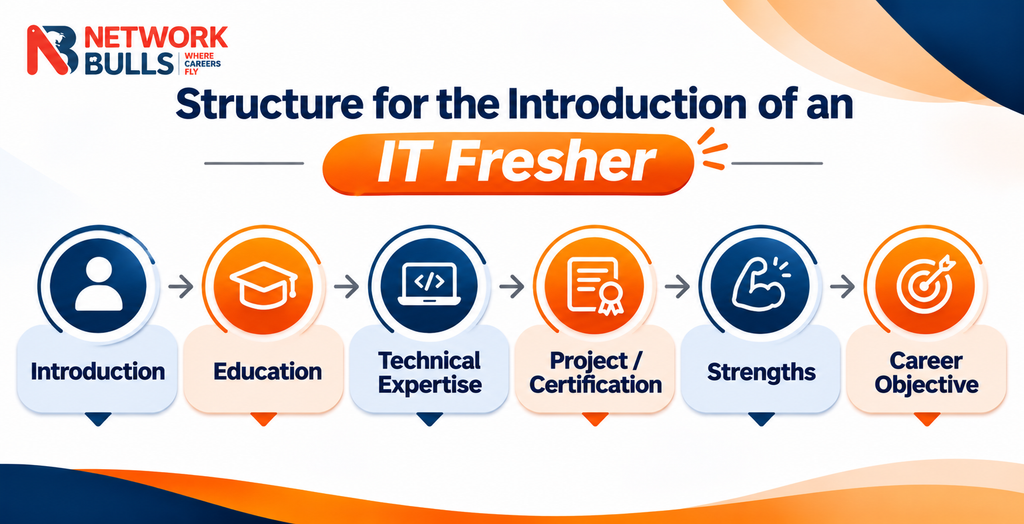
This will ensure that your answer remains professional and will not include unnecessary information.
1. Begin with Yourself
Begin your introduction with who you are and what your present education or profession is.
For instance:
“Good morning. I am Rahul, a graduate in Computer Science, and I have a keen interest in networks and cybersecurity.”
Simple. Direct. Professional.
You do not have to begin with where you were born, raised or anything like that unless asked for.
2. Give a Brief Account of Your Education
Education forms the base for your credentials.
You can include your qualification, specialisation, and educational institution, if any.
Like this:
“Recently, I completed my Bachelor’s degree in Computer Applications, during which I gained a strong knowledge base in programming, computer networking, operating systems, and databases.”
This should not be an exhaustive list of all subjects that you have learned.
3. Mention Technical Skills that Relate to the Job
Here the IT fresher can make the introduction more job-related.
In place of:
“Technical knowledge is very vast.”
Use relevant skills.
“For networking job:
“My technical skills include the basics of networking, TCP/IP, VLANs, routing and switching, subnetting, and basic troubleshooting.”
For cybersecurity jobs:
“Basic understanding has been built on network security, vulnerability assessments, ethical hacking concepts, Linux and security monitoring.”
For a software developer position:
“My technical skills include Python, Java, SQL, Git and web development.”
The most important aspect here is relevancy.
If the job is about networking, then no point spending half the time talking about graphic designing.
4. Speak about your projects
Projects help the freshers to make up for the absence of professional experience.
Although you do not have professional experience working for an organization, still you will be able to show that you have put your learning to use.
Example:
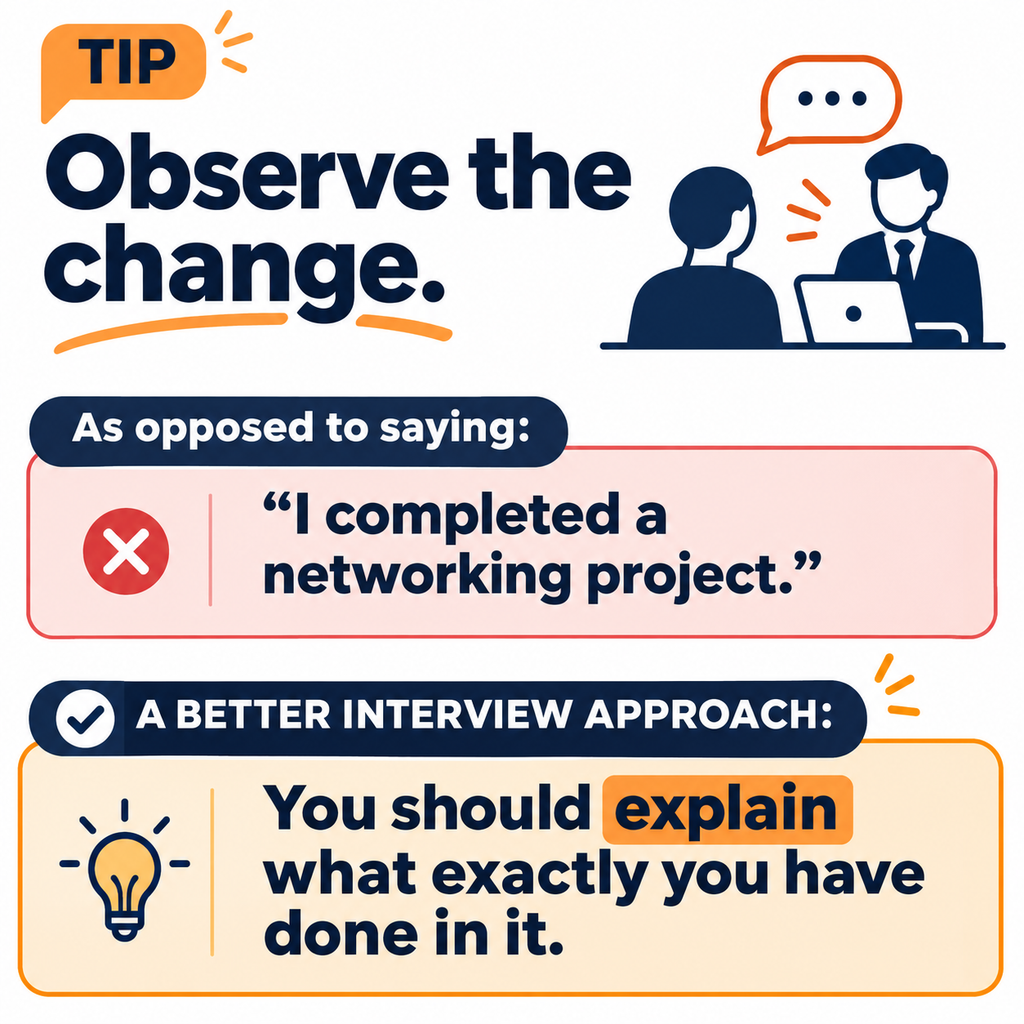
“In my training, I participated in a network project wherein I was able to configure VLANs, inter-VLAN routing, DHCP, and some basic routing protocols in the laboratory environment. It helped me gain knowledge of networking other than just studying it theoretically.”
5. Mention Any Certification/Training
Certifications can enhance your profile, especially for IT positions.
The following certifications can be mentioned:
- CCNA
- CompTIA Network+
- CompTIA Security+
- AWS Certification
- Microsoft Certification
- Cisco Certification
- Linux Certification
- Programming/cloud certification etc.
Example:
“To strengthen my practical networking skills, I completed CCNA training, where I gained hands-on experience with routing and switching, VLAN configuration, subnetting, and network troubleshooting.”
But you should not mention 10 certifications.
Mention only those that are relevant to the job profile.
6. Describe One or Two Professional Strengths
You also need to tell the interviewer what type of worker you are through your introduction.
Make sure you have examples for each of these strengths.
Suitable strengths could include the following:
| S.No. | Strengths |
|---|---|
| 1. | Problem-solving skills |
| 2. | Analytical mind |
| 3. | Quick learner |
| 4. | Communication skills |
| 5. | Teamwork |
| 6. | Detail-oriented |
| 7. | Troubleshooting |
| 8. | Adaptability |
Here’s an example:
“Troubleshooting is one of my strengths. I find it enjoyable to solve any technical problem by breaking it down and analyzing its root cause rather than using guesswork alone.”
It sounds much better than:
“My strengths are hard work and honesty.”
These two qualities are good, but they are too general and very common.
7. Conclude With Your Career Goal
Your concluding sentence must bring everything together and tie it all to the job at hand.
For example:
“I am now seeking a chance where I can use my networking skills in practice, learn from the experts, and develop into a competent network engineer.”
Such a sentence provides a perfect conclusion to your introduction.
It shows the recruiter that you are not just looking for ‘any old job.’
| “Tell Me About Yourself” Sample Answer for an IT Fresher |
| A sample answer for a networking fresher: “Good morning, my name is Rahul. I have recently graduated in Computer Science with networking and IT infrastructure as my areas of interest. During my academic tenure, I have gained a strong understanding of computer networks, operating systems, databases, and programming. To build practical networking skills, I completed a CCNA training course covering TCP/IP, subnetting, VLANs, routing, switching, and troubleshooting. The lab work involved in these concepts also helped me understand how these theoretical concepts apply in real networking situations. I consider myself a fast learner with a strong problem-solving attitude. I am specifically fond of troubleshooting as it gives me an opportunity to analyze and solve problems step by step to find out the root cause of the problem. At this point of my career, I am seeking a platform that would allow me to utilize my technical skills and learn more.” This answer works well because it is short, relevant, organized and specific. |
| Example: For Cybersecurity Fresher |
| In case you are applying for a position in cybersecurity, your introductory part may be as follows: “Hi! My name is Priya, and I’m a fresher interested in cybersecurity. In the course of my education, I was able to learn the basics of networking, operating systems, Linux, and information security. In addition, I completed cybersecurity training, where I gained an understanding of vulnerability assessment, security fundamentals, ethical hacking concepts, and the basics of security. Through lab work, I gained experience analysing various security situations and understanding the impact of vulnerabilities on systems and networks. I’m interested in how attacks occur and, more importantly, how organisations can detect and prevent security threats. Problem-solving and learning new things is something I excel at. Now I am searching for an entry-level job in the field of cybersecurity.” |
Another
Keep Your Answer Within the Right Length
One of the main queries among freshmen is:
“How long should my Tell Me About Yourself response be?”
A suitable aim is about 60–90 seconds.
If you complete your story in 20 seconds, it can mean you are unprepared.
And if you keep talking for five minutes, the interviewer might find it hard to recognize your main qualities.
Your purpose is not to talk but to get the conversation started.
Common Mistakes IT Freshers Should Avoid
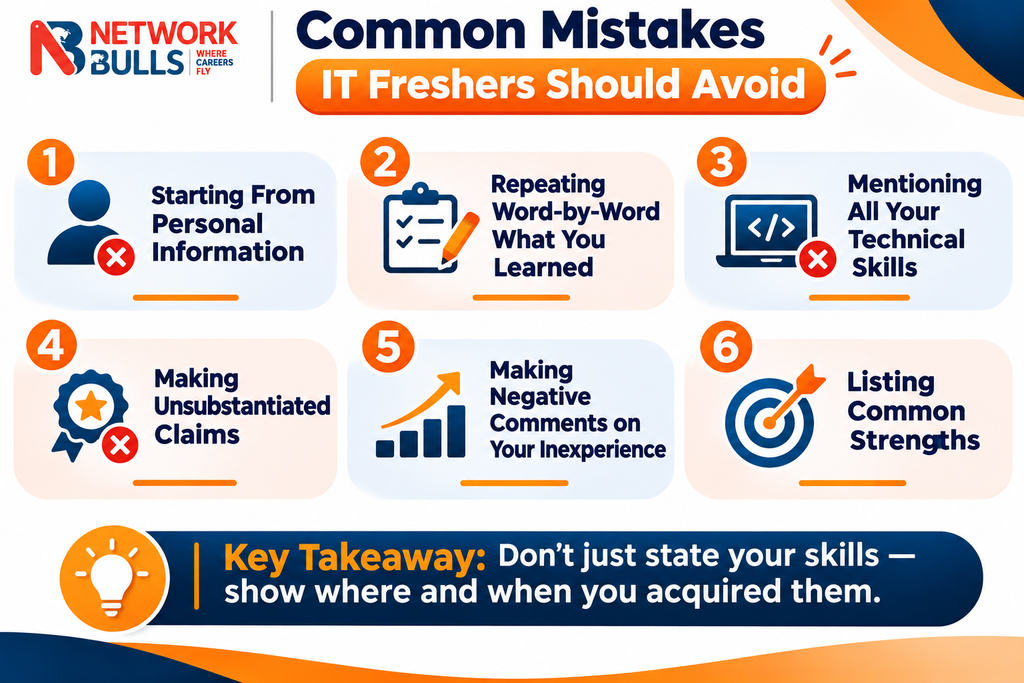
1. Starting From Personal Information
Don’t start with sentences such as:
“I was born in Delhi and did my schooling…”
Your family history or irrelevant data should not be mentioned while making an introduction for a professional purpose.
Only talk about information that is pertinent to the job.
2. Repeating Word-for-Word What You Learned
It is good to prepare but being robotic will shake your confidence.
Remember key points to mention and then speak in your own words:
Education → Skills → Project → Certification → Strength → Goal
3. Mentioning All Your Technical Skills
Never say:
“I know Python, Java, C++, AWS, Azure, Linux, Docker, Kubernetes, CCNA, cybersecurity, SQL…”
If you cannot elaborate on these technologies in your subsequent answers, the interviewer will catch up quickly.
Just mention those skills that you are able to discuss comfortably.
4. Making Unsubstantiated Claims
Do not say:
“I am an expert in networking.”
Being a fresher, you do not need to establish yourself as an expert.
Say:
“I have built a solid base in networking with hands-on experience from labs.”
5. Making Negative Comments on Your Inexperience
Never make your introduction look like an apology.
Don’t use:
“I have no experience since I am a fresher.”
Use the positive angle of your inexperience instead:
“Despite being a fresher, I have gained practical exposure from projects, certifications, and lab work.”
Being a fresher is just a fact – not a negative aspect of yourself.
6. Listing Common Strengths
“A hardworking, passionate, honest, and punctual person” looks like a template.
Make your strength relevant and specific.
For example:
“I love resolving technical problems, and while working in lab practice, I usually solved configuration issues by identifying the problem layer by layer.”
Now you have given your strength context.
Make your answer more impressive
A better fresher introduction always has some kind of evidence.
In lieu of:
“I know networking very well.”
Try:
“I had experience configuring VLANs, inter-VLAN routing, DHCP, and routing protocols in the lab.”
In place of:
“I am interested in cybersecurity.”
Use:
“I became interested in cybersecurity as I learned about ways to identify and resolve vulnerabilities in networks and applications.”
It’s quite easy:
Do not only say that you have certain skills but also show where and when you acquired them.
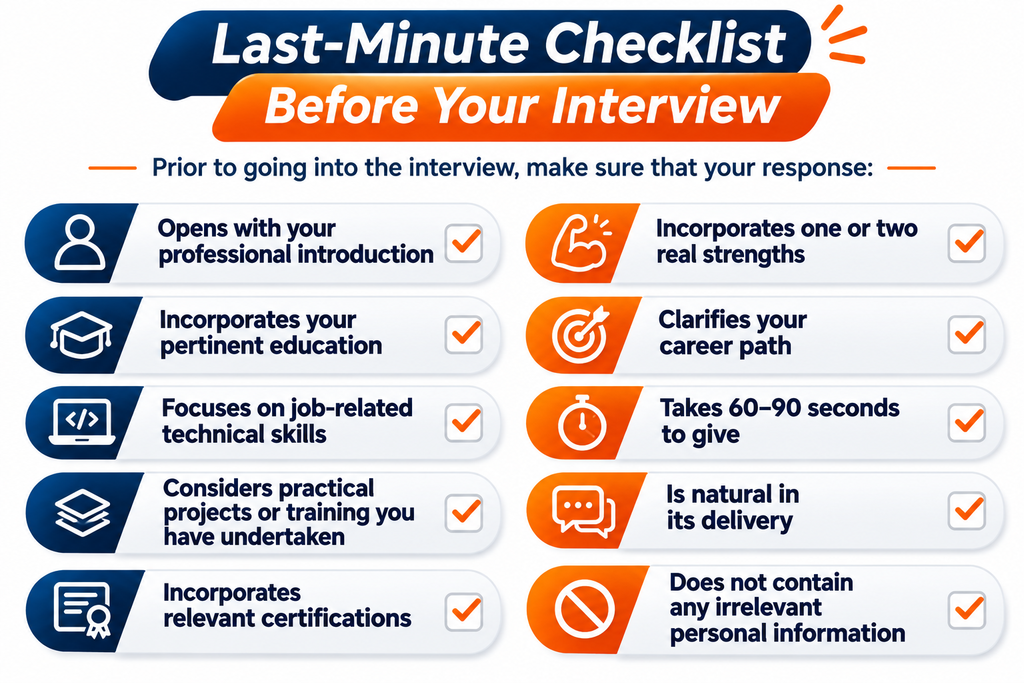
Above all, do not practice writing; practice speaking.
Video yourself answering the question. Listen to the unnecessary pauses, repetitions, and unnecessarily complex sentences. Then repeat.
Conclusion
For an IT fresher, “Tell me about yourself” is not just an interview question but your first chance to introduce yourself professionally.
It does not require years of work experience to make a powerful response.
What you need is clarity, relevancy, confidence, and proof.
Discuss what you have learned and what you have practised. Mention the projects and certifications that truly reflect your skills. Most importantly, make sure that your skills match the position you are applying for.
Remember the golden rule of interviews:
Never provide everything you know to the interviewer. Provide them with the relevant information about yourself.
Proper preparation will help you go from nervous to confident and maybe even secure your first IT job!
Check 100% Job Guarantee Courses
- CCIE Enterprise Infrastructure V1.0/R&S Training in India
- CCIE Security V6.1 Course
- Cyber Security & Network Security Course
- Cloud Security + Network Security Expert
FAQs
The IT fresher must give a brief introduction about their education, technical skills, certifications, projects, strengths, and career goals. This answer must not exceed 60–90 seconds in time and must include only those things that will help him/her get the IT job.
In order to answer the question “Tell me about yourself”, one should begin with his/her current education, then technical skills, projects, certifications, training, strengths, and career goals. It is advisable to make a custom-made introduction about oneself according to the IT job one wants.
The ideal response time for “Tell me about yourself” by an IT fresher is between 60-90 seconds. This should be a precise statement that keeps the interviewer interested while providing enough technical information about oneself.
Some errors that can be made in response to “Tell me about yourself” are elaborating on the personal part, mentioning too many skills, memorizing the entire response, making false statements, talking ill about being fresh and not having any prior experience.
A fresher can make his introduction effective by talking about his technical expertise, laboratory knowledge, certificates, projects done academically or personally, and experience in troubleshooting. More importantly, prove your points through examples rather than simply listing your skills.