Picture yourself walking into a modern conference room with butterflies in your stomach, only to be greeted by your interviewer asking, “Take me through the process of resolving issues with VLANs not propagating as expected.” You may feel nervous, but if you have prepared adequately for the interview with the right combination of basic and advanced level interview questions, then you will walk out with flying colors. The field of networking is highly dynamic and CCNA/CCNP certifications have become a key factor in landing jobs at leading IT firms, ISP companies, and enterprises. Here comes the catch! This list of questions is anything but dull. Instead, this guide serves as your ultimate preparation tool filled with insights and analogies to help you ace that 2026 networking interview whether you are a beginner looking for your first networking job or aiming for a senior network engineering role, this will help you build the knowledge and confidence needed to perform well in technical interviews.
Why CCNA and CCNP Are Still the Gold Standards of the Network Job Market
Networking is the invisible force that makes all possible. Whether you watch Netflix or use cloud computing technologies, networks behind the scenes make the difference. Cisco certifications such as CCNA (entry level) and CCNP (professional level) have always remained benchmarks because they certify real skills in routing, switching, securing, automating, and so forth.
It doesn’t matter how well candidates know the theoretical basics of networking when employers need somebody to configure BGP peering at 2 AM. Thus, CCNA provides a candidate with solid knowledge about networking, while CCNP gives professional insights into large-scale network designing, SD-WAN, automation with Python/Ansible, and security.
CCNA Interview Questions: Building a Strong Foundation
CCNA interview questions evaluate your knowledge of fundamental principles. Prepare yourself for both theory and application-based questions. Following are some handpicked questions with answers and additional insights.
- The OSI Model & The TCP/IP Model: Basic Network Concepts
Question: What is the OSI model? What is its connection with the TCP/IP model?
Answer: The OSI model comprises seven layers, which include the physical layer, data link layer, network layer, transport layer, session layer, presentation layer, and application layer. On the other hand, the TCP/IP model contains only four layers. You can consider the OSI model as being highly detailed while the TCP/IP model acts as a map in your travels.
You might view it as the way to diagnose networking problems step-by-step.
Additional tip: It will be easier for the learner to understand encapsulation and decapsulation when you discuss it using a letter inside envelopes to send by post.
Follow-up question: What happens when you enter a website address into a browser?
2. IP Addressing, Subnetting, and Routing
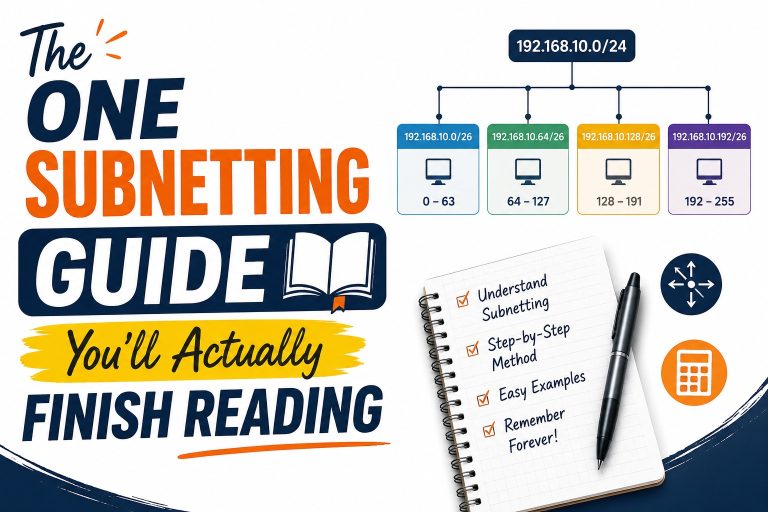
Question: What is meant by subnetting? Describe how to subnet a /24 network into six subnets.
Answer: Subnetting refers to breaking up a single large network into multiple smaller networks for improved performance and security.
Let’s take 192.168.1.0/24. In order to subnet into 6 networks, you will need to borrow 3 bits (2³ = 8). New subnet mask: /27. Each subnet will have 30 host addresses (2⁵ – 2).
Subnets:
- 192.168.1.0/27
- 192.168.1.32/27
- 192.168.1.64/27 etc.
Easy example: Just imagine that you split your high-rise into separate floors so that everyone does not live on a single floor.
Preparation Questions:
- Difference between IPv4 and IPv6?
- Static v/s dynamic routing?
- Default route – where do we use it?
3. Switching, VLANs, and STP
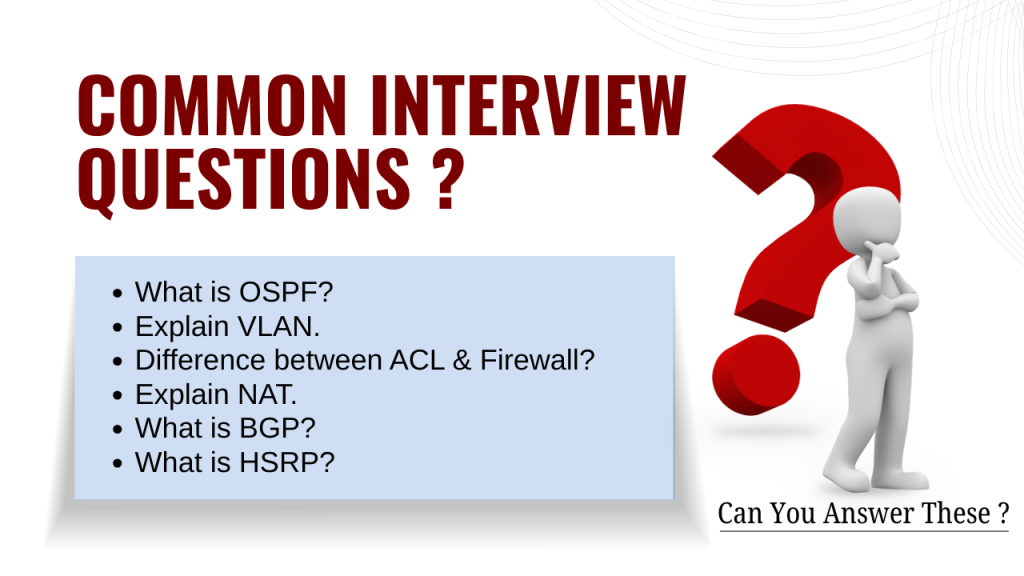
Question: What is a VLAN, and what benefits does it offer to the network?
Answer: It is a logical separation of devices residing in one physical switch.
Advantages: management of broadcast traffic, security (because devices in other VLANs cannot communicate with each other without routing), flexibility. Set up using the switchport access VLAN x command.
Associated Question: STP and its necessity (to avoid loops). Mention RSTP (Rapid Spanning Tree Protocol).
Pointers for Quick Reference:
- Access and Trunk ports difference
- Dot1Q and Native VLAN
- Etherchannel technology
4. Routing Protocols (OSPF, EIGRP)
Question: What is the difference between Distance Vector and Link State protocols?
Answer: OSPF builds a network topology through LSAs (link state advertisement), fast convergence, and cost-based routing metric. EIGRP is a Cisco proprietary protocol (hybrid protocol) which works on rapid convergence using the DUAL algorithm.
Question:How to configure basic commands?
Answer: Then use the verification commands ‘show ip route’, ‘show ip ospf neighbor’, ‘show ip eigrp neighbors’.
5. Security & Basic Troubleshooting Questions:
Question: Explain ACLs, NAT, and how to troubleshoot connectivity problems?
Answer: ACLs stand for Access Control Lists, where network traffic is filtered using packet acceptance or rejection. NAT converts private IP addresses to public IP addresses, including three main types: Static NAT, Dynamic NAT, and Port Address Translation (PAT).
In troubleshooting, one needs to first test the physical connectivity and then find out about the problem layer-by-layer through various commands such as ping, traceroute, and show commands.
Tip: Scientific Method is used in troubleshooting and interviewing by hypothesizing and testing the layer one by one.
Transitioning to CCNP: Leveling Up Your Expertise
CCNP focuses more on design, optimization, and automation concepts. Scenario questions and concepts such as SD-WAN will be covered in the course.
- Advanced Routing and High Availability
Question: Compare OSPF and EIGRP. Where would you use which protocol?
Answer: OSPF is an open standard protocol and hierarchy through areas; EIGRP is proprietary to Cisco (later open standard), converges faster, and is simpler to configure, but is not recommended for multi-vendor networking. OSPF uses DR/BDR for multiple access.
Problem: No OSPF neighbor established—what are the troubleshooting steps? (Check area ID, timers, MTU, authentication).
2. Enterprise Topics: BGP, VPN, QoS, SDWAN, Automation
Important CCNP Questions:
Question: What is BGP and how does it work?
Answer: Path vector protocol using AS-Path for loops avoidance and best path calculation; MED affects inbound traffic.
Question: What is IPsec Site-to-Site VPN?
Answer: Secured and encrypted tunnel between two locations using IKE for key negotiation and ESP to encrypt traffic.
Question: What is DMVPN?
Answer: Dynamic multipoint VPN; Phase 1 – hub-and-spoke, Phase 2 – dynamic spoke-to-spoke, Phase 3 – optimized with NHRP redirects.
Question: What are QoS Marking, Policing, Shaping?
Answer: Marking marks traffic, Policing discards traffic exceeding the limit and shaping queues the excess traffic.
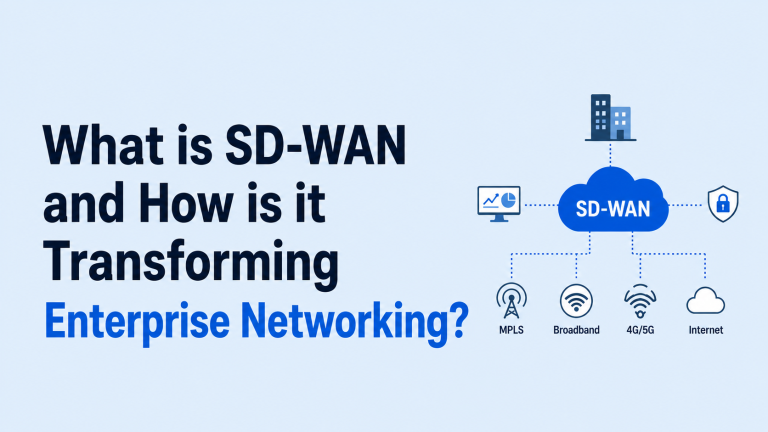
Question: What are SD-WAN benefits and components?
Answer: Centralized management, dynamic path optimization, cost reduction; uses vManage, vSmart, vEdge, vBond.
Interesting Perspective: BGP is similar to international politics, the way autonomous systems negotiate and agree on routing with policies.
With automation (using Python scripts to configure), you go from a firefighter to an architect.
3. Network Services, Security and Wireless (CCNP Security/Enterprise)
Important CCNP Questions:
Question: What is HSRP, VRRP, GLBP?
Answer: HSRP – Cisco active/standby protocol, VRRP – standard protocol, GLBP – Cisco active/active protocol.
Question: What is Static NAT, Dynamic NAT & PAT?
Answer: Static (one to one), Dynamic (with pool), PAT (many to one with port numbers).
Question: What is the difference between ACLs and Firewalls?
Answer: ACLs are basic packet filtering; Firewalls are stateful devices with more advanced inspection capabilities.
Question: Wireless terminology: Controllers, AP modes, WPA3?
Answer: Centralized wireless controller (WLC); AP in Local/FlexConnect modes; WPA3 with SAE encryption.
Preparing like a Pro to Nail the Interview
| Practical Training: Gain experience of working with the Cisco Packet Tracer, GNS3, in VLANs, OSPF, ACLs, NAT, and troubleshooting scenarios. |
| Be Prepared to Explain Networking Scenarios: Be prepared not just to describe concepts, but to give examples of how to solve real networking problems. |
| Take Mock Interviews: Practice answering networking questions orally to become more confident and improve communication. |
| Keep Up with Industry Trends: Get knowledge of cloud networking, network automation, SD-WAN, and cybersecurity. |
| Show Your Work: Include your labs, automation scripts, and projects in GitHub. |

Final Thoughts!
The success in getting your dream networking job does not depend on how perfect you are but on being prepared, passionate about work, and communicating well. You can rely on CCNA to acquire basic skills, while CCNP certification allows you to step up into seniors positions. Treat each interview as a professional conversation where you can confidently demonstrate your knowledge and problem-solving skills.
In the networking field, it is actually individuals capable of handling their jobs successfully that matter. Thus, keep improving yourself by updating your LinkedIn profile, connecting with your professional colleagues, and acquiring more information. Your dream job may just be an answer away. Start now and in no time you’ll find yourself asking these questions!
Frequently Asked Questions!
Questions related to the basics of networking like OSI model, TCP/IP, subnetting, VLAN, routing protocols, IP addresses, and troubleshooting skills are asked in a CCNA interview.
CCNP interviews involve testing the knowledge of more advanced topics like OSPF, BGP, EIGRP, SD-WAN, QoS, VLAN, and network security among others. Practice using Cisco Packet Tracer/GNS3/Cisco CML on a regular basis.
Companies usually combine both theoretical and practical questions in their interview process. Even though they focus on assessing your knowledge about networking concepts, at the same time, they want you to explain how you can solve different networking issues.
Yes. Practical lab practice can be considered one of the most crucial factors at the interview stage for networking jobs because building and troubleshooting labs shows that you have practical knowledge and experience which will make you more competitive compared to people who have only theoretical knowledge.
Yes. Having CCNA certification, you can apply for entry-level positions like Network Support Engineer, NOC Engineer, Junior Network Engineer, etc. Nevertheless, having both certification and lab experience will increase the probability of finding a more suitable position.