Home » OSPF vs EIGRP: Which Routing Protocol Performs Better?
Technology
OSPF vs EIGRP: Which Routing Protocol Performs Better?
By Network Bulls ·
Nowadays, choosing the appropriate IGP routing protocol is very important since there must be efficient performance, scalability, and availability of enterprise networks. There are two main contenders that often win over other options when considering their advantages in various situations, OSPF and EIGRP (Interior Gateway Routing Protocol).
It doesn’t matter if you are an IT specialist working on the design of network systems or you simply learn this field for getting certified in Cisco equipment (CCNA or CCNP), in both cases you must be aware of all features of these protocols.
This article is aimed at helping you distinguish OSPF from EIGRP and to see which one of them suits better.
Why Routing Protocols Are Required
Routing protocols play an important role in helping routers establish dynamic learning of the paths between nodes in a network.
In the absence of such protocols, network managers will have no choice but to establish static routes by configuring each individual node – a daunting task especially for large networks comprising many nodes.
Routing protocols ensure automatic route sharing of information between routers. Thus, they facilitate effective path selection, adaptation of changes such as a link failure, establishment of new routes, and distribution of traffic. In modern environments where connectivity is achieved from clouds and data centers, routing protocols play an important part in ensuring communication.
Problems That They Solve
There are various issues that routing protocols can solve, including:
Loop Detection: They have systems for avoiding loops that would otherwise result in packet storms.
Slow Convergence: Manual or old-fashioned approaches create long downtimes during failures; routing protocols reduce these.
Network Scaling Problems: As the size of the network grows, static routing is unable to cope with the thousands of routes.
Path Suboptimization: Routing protocols use metrics such as bandwidth and delay to find the best path.
Redundancy: Automatic switching to backup links helps provide more reliability.
OSPF Protocol: The Link-State Routing Protocol
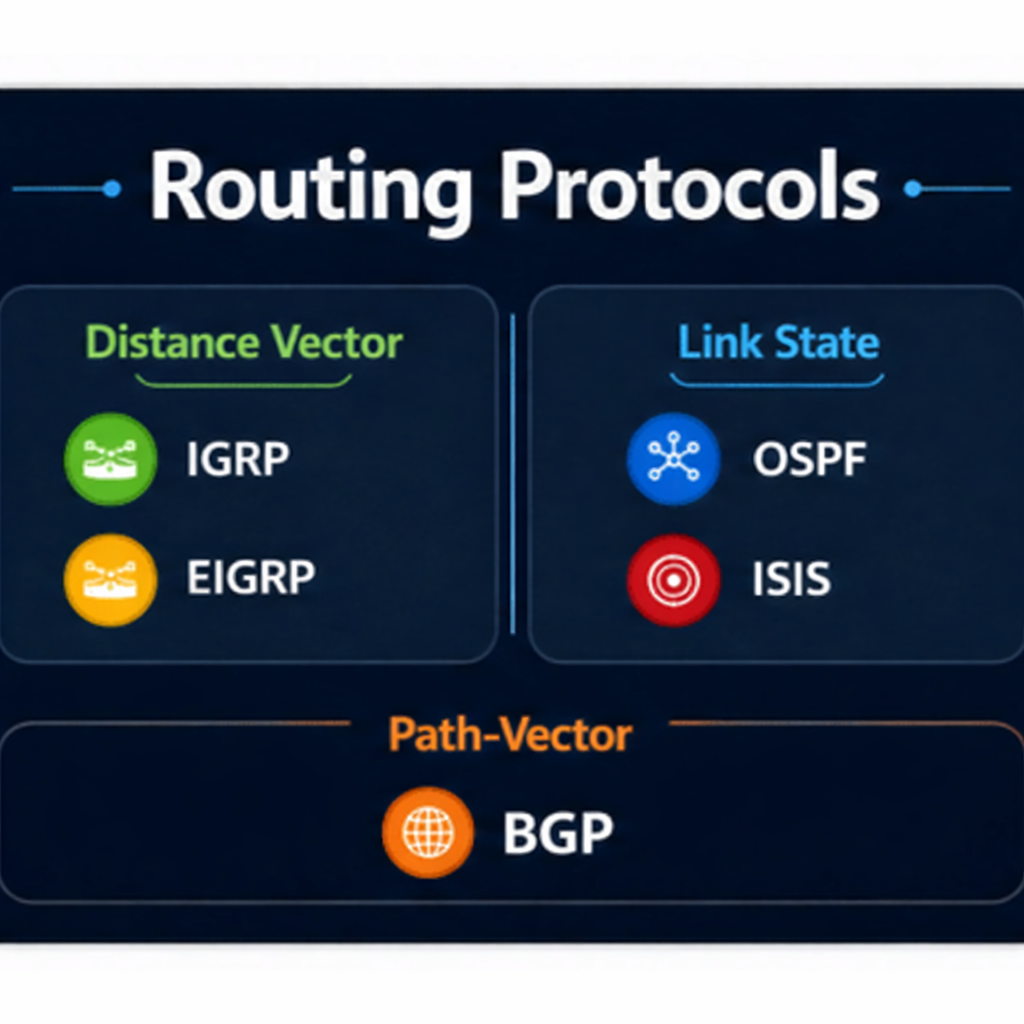
OSPF is a widely used, open source link state routing protocol developed by the Internet Engineering Task Force (IETF) and its latest versions, namely OSPFv2 (IPv4) and OSPFv3 (IPv4/IPv6), were published recently.
The SPF (Shortest Path First) algorithm is used in OSPF to compute the best paths through a routing domain. Unlike the distance vector routing protocol, which retrieves route information from its neighbors, an OSPF router is aware of the whole network topology, and thus creates its own LSDB.
Technical Characteristics of the Protocol:
Hierarchical structure of Areas, including area 0 (backbone) connecting all other areas for decreased flooding.
Convergence via triggered and LSA flooding.
Ability to support authentication, summarization, and stub areas.
Metrics are defined by reference bandwidth to interface bandwidth ratio (Cost = Reference Bandwidth / Interface Bandwidth).
Use of multicast communication (224.0.0.5 and 224.0.0.6 addresses).
OSPF performs very well in environments with a need for standardization, interoperability, and transparency, working effectively with hardware from multiple vendors such as Cisco, Juniper, Arista, and Huawei.
Introduction to EIGRP: Cisco’s Hybrid Protocol
EIGRP is a protocol designed by Cisco, and can be either termed as an advanced version of distance vector protocols or termed as the hybrid protocol. This protocol is the best blend of distance vector protocols like IGRP, as well as link state routing protocols, using DUAL to find loop free paths quickly.
Unlike other distance vector protocols, where periodic exchange of full routing table information occurs, EIGRP does partial exchange of information about network status.
Technical Characteristics:
Includes Neighbor Table, Topology Table, and Routing Table.
Includes Feasible Successors concept that allows for quick failover.
Takes into account multiple factors in composite metric: bandwidth, delay, load, and reliability (althoughbandwidth and delay are mostly utilized).
Unequal-cost load balancing enabled by the variance command.
Includes automatic summarization and manual route summarization.
Works very well with VLSM and CIDR.
Although EIGRP used to be considered 100% proprietary, a basic version of EIGRP was made open source in 2013. Yet, Cisco continues to develop its full-blown implementation.
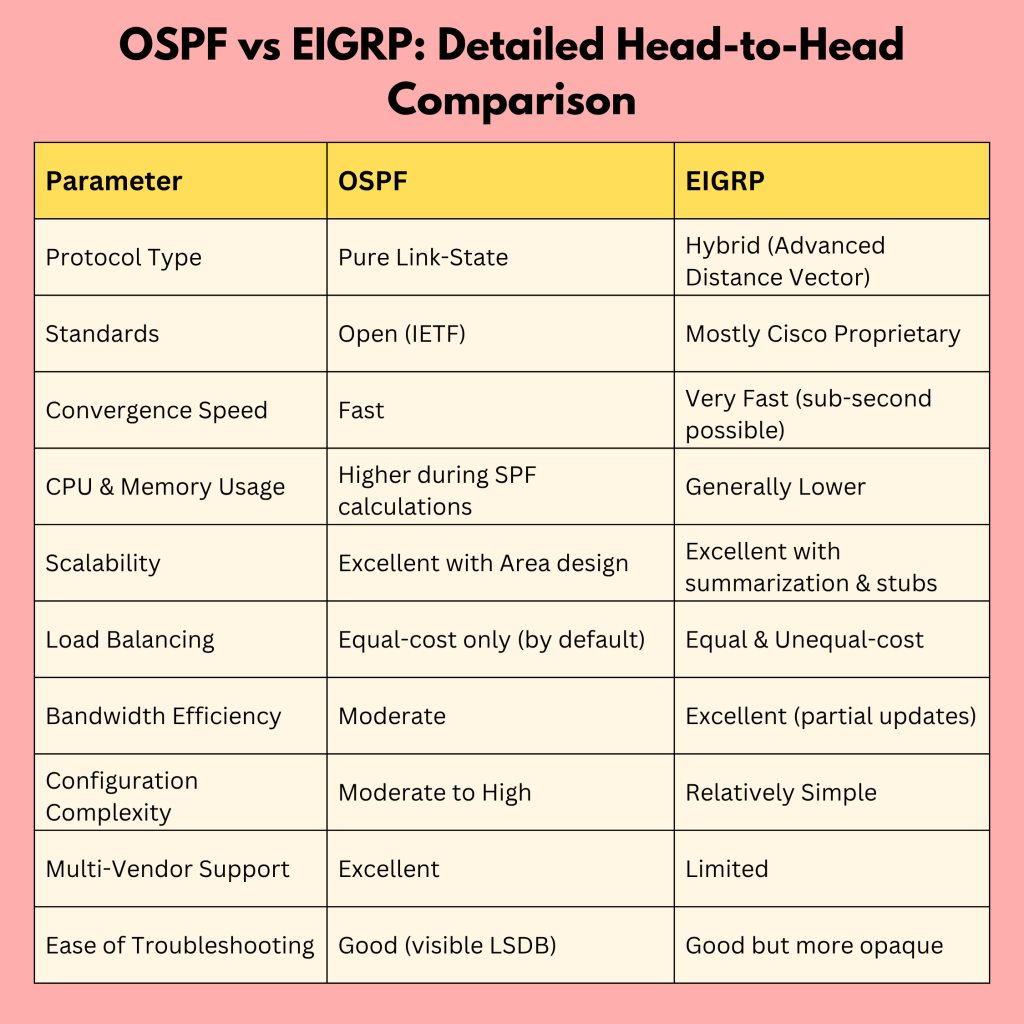
OSPF vs EIGRP: Detailed Head-to-Head Comparison
Let’s break down how these protocols compare across critical parameters:
Performance Evaluation: Actual Metrics That Count
Convergence Time
EIGRP typically recovers from network failures faster than OSPF, making network convergence quicker and minimizing traffic disruption.. While there may be no convergence delay at all when switching to a Feasible Successor following the failure of one of the links, OSPF will need some time to flood LSAs and calculate the new SPF. Nevertheless, features such as Bidirectional Forwarding Detection, Incremental SPF, and OSPF Fast Hello have reduced the gap.
Resource Usage
Whereas EIGRP is not so resource-intensive on routers since there is no complete link state database in the protocol, the SPF algorithm of OSPF is CPU-intensive whenever there is a modification in network topology. Consequently, EIGRP must be implemented wherever router resources are limited, such as in branch offices.
Scalability and Big Deployments
While both protocols perform well in big deployments, there are differences in how each does it. Area-based structure in OSPF is especially useful in deployments of a larger number of routers. By dividing the network, you will have LSA flooding and SPF computation limited to certain areas. Proper summarization points and stub routes are crucial for successful implementation of EIGRP.
Load Balancing Capabilities
Unequal-cost load balancing works better in EIGRP. With help of the variance command, network administrators can effectively balance traffic load on various speed connections. Equal-cost load balancing is supported by OSPF.
Real-World Deployment Scenarios
Multi Vendor Infrastructure ⇒ Use OSPF
The organizations deploying equipment from more than one vendor prefer OSPF since it promotes interoperability without creating vendor dependency. It is widely seen in service provider networks and modern enterprises adopting digital technologies.
Huge Hierarchical Organization ⇒ OSPF Works Excellent
The organizations having thousands of routers find OSPF’s support to partition the network into areas useful for their stability and ease of troubleshooting purposes.
Quicker Deployment ⇒ EIGRP Is More Simple
The mid-sized organizations using all Cisco-based networking infrastructure tend to deploy EIGRP due to its easier implementation compared to OSPF. Its straightforward configuration and reduced complexity help organizations deploy and manage networks more efficiently.
Factors to Consider Before Choosing
Existing Vendor Landscape: Pure Cisco or hybrid?
Network Size and Scalability Needs: Flat or hierarchical?
Focus on Performance: Speed of convergence or scalability?
Knowledge of Staff: Area designs or DUAL process?
Forward Compatibility: Future SD-WANs or clouds?
The choice of a routing protocol should be based on the overall needs of the network rather than applying the same solution everywhere.
Future Trends: OSPF vs EIGRP in 2026 and Beyond
As modern networks continue to adopt technologies such as SD-WAN, network automation, and Intent-Based Networking (IBN), OSPF is expected to remain a preferred choice due to its flexibility, scalability, and vendor-neutral design. It also integrates more easily with emerging technologies such as Segment Routing (SR), making it well-suited for future network architectures.
EIGRP, however, continues to play an important role in Cisco-centric environments, especially within Cisco DNA Center and SD-Access deployments, where its simplicity and fast convergence remain valuable advantages.
In summary, OSPF is generally considered more future-ready for multi-vendor and large-scale networks, while EIGRP remains a strong option for organizations that primarily use Cisco networking solutions.
Final Thoughts!
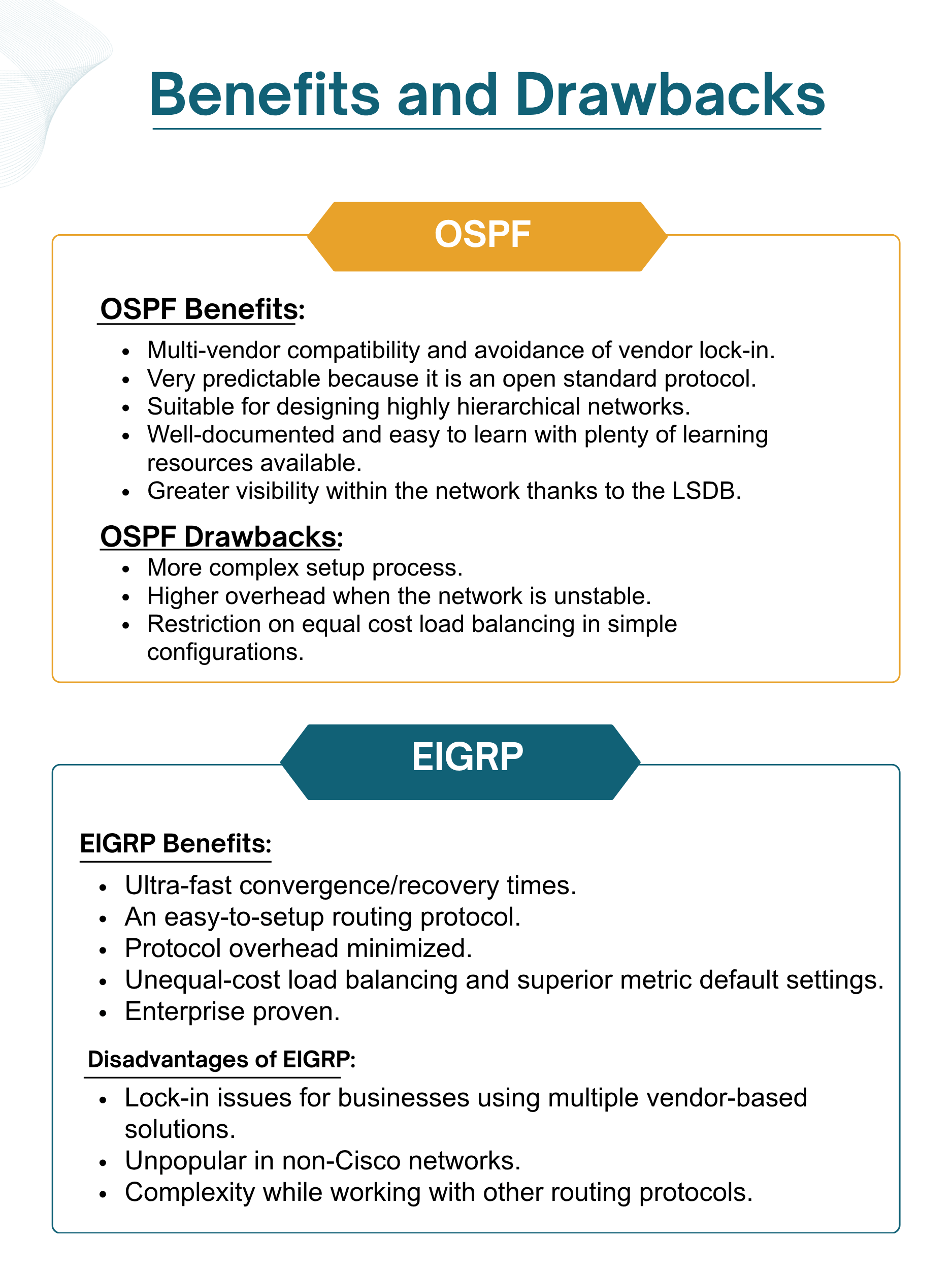
Which is a more preferred protocol, EIGRP or OSPF? There is no definite solution to this issue. EIGRP functions better due to its fast convergence, low CPU usage, and load balancing. On the other hand, OSPF offers greater flexibility and scalability with fewer restrictions.
It depends on what technologies you already use, what goals you want to achieve, what competencies you have at the moment, and how you plan to scale further. Networks that started using EIGRP because of its straightforwardness tend to adopt OSPF in the future to be more flexible and independent. Having a good understanding of both of these protocols will always be an important skill for a network engineer.
If you know the specifics of each protocol, you can design much more reliable and scalable networks. Are you ready to make your routing more efficient? Analyze the current state and try out different protocols in the lab environment.
EIGRP works well in homogeneous Cisco networks where high speed and simplicity are essential, but OSPF protocol suits heterogeneous and multi-vendor environments much better.
Which converges faster? EIGRP or OSPF?
Absolutely, EIGRP always converges faster due to Feasible Successor technology although recent advancements allowed OSPF protocol to converge as quickly as EIGRP does.
Is it possible to apply EIGRP and OSPF protocols together?
Indeed, there are many networks where a mixture of these two protocols is implemented, applying route redistribution, with EIGRP used around the network border and OSPF in the backbone.
Are there any multi-vendors with EIGRP protocol?
There are multi-vendor implementations of EIGRP protocols, but all the functionality is only available on Cisco devices, which makes OSPF a great choice in heterogeneous networks.
Which protocol is easier to implement and configure?
EIGRP seems to be quite an easy protocol to configure since it is quite simple to manage compared to OSPF, whose configuration requires more expertise due to area approach.