Are you struggling to choose between CCIE Security v6.1 or CCIE Enterprise v1.1? With the increasing number of networking threats, businesses are looking for professionals who can not only protect their networks but also design and manage large networks.
This is where CCIE Security and CCIE Enterprise certifications come into the play.
To start with, CCIE Security is for those who want to get into the field of security and protect businesses from network-based threats, unauthorized access, and policy violations. Whereas, CCIE Enterprise is for those interested in building, managing, and improving large-scale IT networks.
Both the CCIE Security v6.1 and Enterprise v1.1 Certifications provide opportunities to top-level jobs, global prospects, and high salaries. And choosing one over the other depends on several factors. In fact, both these certifications are designed for two different career paths and one should know everything about these certifications in detail before they make their decision.
In this article, we will help you understand CCIE Security vs CCIE Enterprise clearly and choose the path that best suits your skills, interests, and long-term career goals.
Let’s get started!!
What is CCIE Security?
As mentioned above, CCIE Security is an expert-level certification for professionals who aim to master the skills of security. Today, businesses often face the requirements of advanced secure remote connectivity, cloud adoption challenges, and identity-based network control.
CCIE Security trains the individuals to design and operate security systems capable of defending organizations against modern attacks.This certification by Cisco focuses on end-to-end security i.e. from devices and users to data, applications, and the cloud. It prepares the individuals to master the skills to secure IT infrastructures and automate security operations for large networks.
- Prerequisites of CCIE Security Training
There are no prerequisites required in order to get CCIE Security certification. You can directly appear for the exam. However, Cisco recommends having:
- 5–7 years of experience in network or security roles
- Strong understanding of routing, switching, VPNs, firewalls, and network policies
- Experience with troubleshooting real networks
- Exposure to network security platforms and basic automation
Although it is not compulsory, most aspirants pursue CCIE Security after CCNA/CCNP certification.
2. About the Exam
To appear for CCIE Security exam aspirant must pass 350-701 SCOR written exam.
To achieve the CCIE Security certification, a candidate must pass:
- Lab Exam v6.1 (8 Hours)
This is a practical exam that tests your skills in designing, configuring, troubleshooting, and securing an actual enterprise network.
It is a two-step process to ensure that you have theoretical as well as practical, real-world experience.
3. CCIE Security – Topics Covered
| Topic | Key Areas Covered |
| Network Infrastructure Security | Securing routers, switches, wireless networks; Network segmentation & access control |
| Next-Generation Firewalls & Intrusion Prevention | Configuring firewall policies; Application-level filtering; Threat prevention & malware protection |
| VPN & Secure Remote Access | Site-to-site VPNs; Remote worker access; Secure branch connectivity |
| Identity & Access Control (Zero Trust) | Device/user authentication; Role-based access; Network visibility & posture checks |
| Cloud Security (Cisco Umbrella) | DNS security; Cloud Access Security Broker (CASB); Secure Web Gateway; Firewall-as-a-Service |
| Security Automation & Programmability | Using APIs; Python automation; Automating Policy Deployment |
| Centralized Security Management | Manage security policies from a single platform; Monitoring & orchestration using Cisco Catalyst Center |
4. Job Roles After CCIE Security
A CCIE Security certification will open the door to advanced network and cybersecurity careers in various industries. Some of the job roles are –
- Network Security Engineer – The Network Security Engineer focuses on firewalls, VPNs, Intrusion Prevention Systems, and secure access to networks. They also play a key role in monitoring network security and implementing best practices to ensure that key systems are secure.
- Security Analyst/SOC Engineer – The key responsibilities will include real-time monitoring for security alerts, identifying and responding to threats. Additionally, they will be playing a key role in analyzing logs and incidents, and creating and enforcing security policies to mitigate security breaches.
- Security Consultant/Specialist – They will help organizations assess their security environment and create an effective security infrastructure. Also, they assist organizations in meeting compliance requirements and standards.
- Network Engineer (Security-Oriented) – Network Engineers use their networking knowledge and combined with security responsibilities, they will secure networking devices such as routers and switches, and also secure Wireless networks using proper access control measures.
- Security Architect / Enterprise Security Architect – They are responsible for designing an integrated network-wide security solution for an enterprise and designing enterprise-wide security solutions and then deploying those policy across on-premises and in cloud environments.
5. CCIE Security V6 Integrated Course at Network Bulls
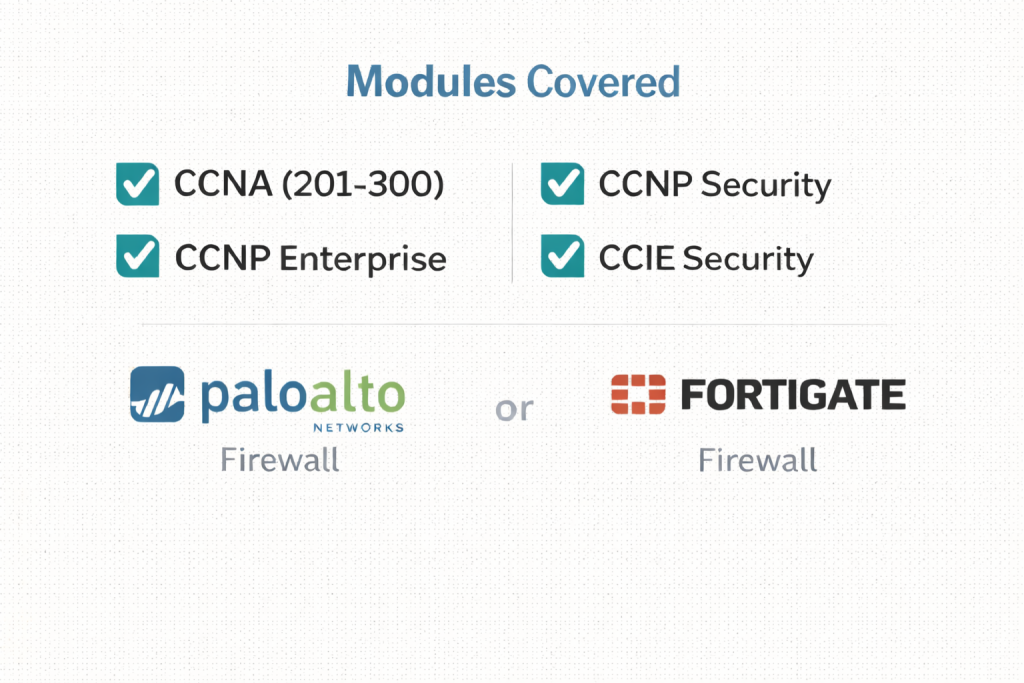
The CCIE Security V6.1 Integrated course at Network Bulls is an exclusive course that includes the integration of Cisco Routing & Switching with Cisco Network Security training together. In this course, students develop their skills as both Network Engineers and Network Security Engineers.
CCIE Security V6.1 (Written + Lab)
What is CCIE Enterprise (Enterprise Infrastructure)
The CCIE Enterprise Infrastructure is a Cisco expert-level certification that validates one’s skills in designing, deploying, operating, and optimizing complex enterprise networks. It will cover routing and switching, network virtualization, SD-WAN, automation, dual-stack IPv4/IPv6, and the integration of secure network services.
The certification positions you as a top-level network expert capable of managing large-scale enterprise infrastructure, ensuring high performance, scalability, reliability, and future-ready automation.
- Prerequisites of CCIE Enterprise Training
There are no formal prerequisites required by Cisco to attempt CCIE Enterprise. However, the below skills can help –
- Experience working on network automation, programmability, and SDN/SD-WAN technologies is highly desired.
- Basic knowledge of network automation, programmability, and SDN/SD-WAN technologies.
2. About the Exam
The CCIE Enterprise Infrastructure certification requires the individuals to pass the two exams:
- Core Written Exam (350–401 ENCOR)
- It covers enterprise network infrastructure, OSPF, BGP, security, automation, and network services.
- MCQs and scenario-based questions.
- Validates foundational and advanced knowledge required for the lab exam.
- CCIE Enterprise Infrastructure v1.1 Lab Exam
- It includes a practical exam that tests real-world enterprise network configuration, troubleshooting, and integration.
- Involves assessment with tasks on routing, switching, SD-WAN, SD-Acess, automation, and network assurance.
The candidate must pass both exams to obtain the CCIE Enterprise Infrastructure certification.
3. Topics Covered in CCIE Enterprise Certification
| Topic | Key Areas Covered |
| Enterprise Network Infrastructure | Advanced routing and switching; VLANs, trunking, spanning tree, QoS; Network virtualization. |
| Software-Defined Infrastructure | SD-WAN; SD-Access / Software-Defined Networking; Network automation and programmability |
| Network Services & Security Integration | Network assurance; Basic security implementation; High availability and redundancy |
| Dual-Stack Networking | IPv4 and IPv6 design, implementation, and troubleshooting |
| Infrastructure Management | Monitoring, optimization, and troubleshooting tools |
| Network Automation & Programmability | Python scripting for automation; APIs for configuration and monitoring; Automating network deployment and tasks |
4. Job Roles After CCIE Enterprise
The CCIE Enterprise Infrastructure certification can open a whole new world of advanced possibilities in networking within large organizations, data centers, service providers, and consulting firms. Typical job roles include:
- Network Architect / Solutions Architect: Plan, design, and deploy enterprise-scale networks; integrate SD-WAN and SDN for high-performance, scalable, and reliable solutions.
- Senior / Lead Network Engineer: Oversee advanced routing and switching; troubleshoot enterprise infrastructure and lead SD-WAN deployments.
- NOC / Network Operations Center Engineer:Oversee enterprise networks, perform incident response, and ensure smooth operations.
- Pre-Sales / Technical Consultant: Designs solutions for enterprise networking and presents technical proposals to the client while providing expert guidance to the sales teams.
- IT Manager / Project Manager (Network-Focused): Lead network projects, manage teams maintaining enterprise infrastructure, and ensure projects are delivered on time and within scope.
5. CCIE Enterprise Infrastructure V1.1 Course at Network Bulls
Network Bulls offers –
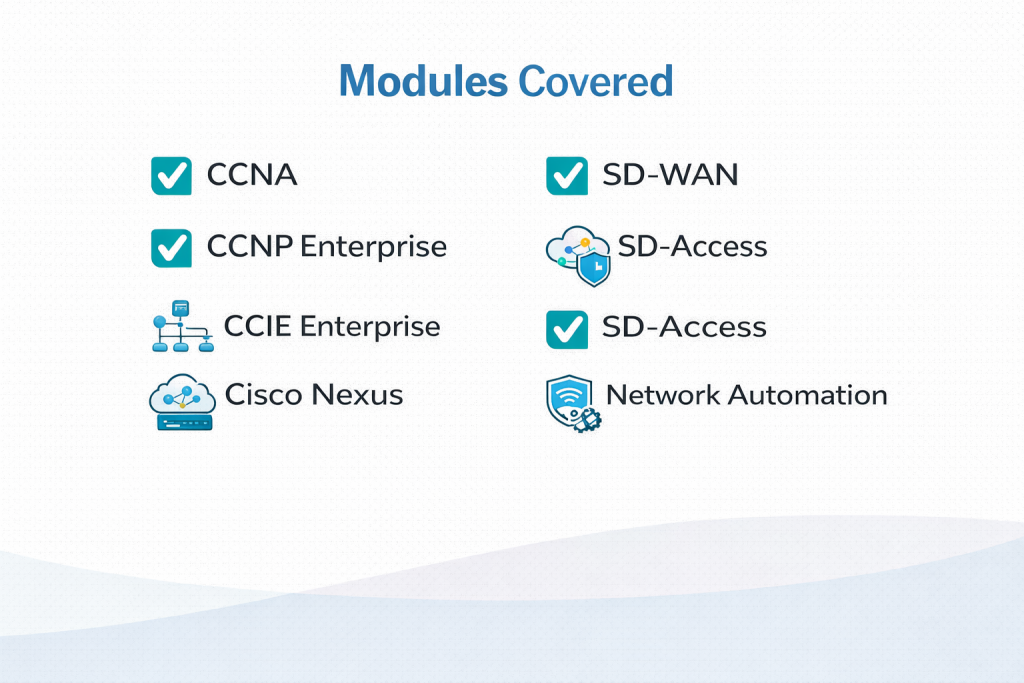
a CCIE Enterprise Integrated Training Program that leads students from beginners to an expert level, training them for CCNA → CCNP Enterprise → CCIE Enterprise Infrastructure V1.1 successively.
The course is structured to provide a 100% placement guarantee for graduate students. Candidates, after completing the course structure, can either begin preparation for the CCIE Enterprise Infrastructure Lab exam or connect with the respective placement network of NB for job opportunities.
CCIE Enterprise Infrastructure (Written + Lab)
Companies That Hire CCIE Professionals
- IT Services & Consulting Firms: HCL, Wipro, Tech Mahindra, Accenture.
- Large Enterprises: Banks, telecom companies, healthcare organizations, data centers.
- Service Providers / MSPs / SOCs: those companies offering managed security services, or network security consulting services.
- Cloud & Technology Companies: Multinational companies with large-scale network infrastructure and cloud adoption.
- Government & Defense Organizations: Protecting critical infrastructure.
Conclusion
CCIE Security and CCIE Enterprise Infrastructure are two of the most well-regarded and sought-after Cisco certifications in the IT industry. The answer to the question “CCIE Security vs CCIE Enterprise – Which is better?” depends on your individual goals.
For those whose area of interest involves Network Security; securing an organization’s networks against cyber attacks, both courses would position a student well to enter into a high demand job positions(Solutions Architect/Network Architect(Security Analyst, Network Security, Security Architect or Engineer, as they are referred to) offering very lucrative salaries, up to ₹12,00,000 per annum to over 24,000 USD (USD Internationally).
On the other hand, students interested in Enterprise Infrastructure would be more oriented towards Core Enterprise Networking and Routing & Switch. With the CCIE Enterprise Infrastructure course, it is possible to gain access to Advanced Job Roles including Circuit Engineer, Senior Network Engineer, or Solutions Consultant, with an average starting salary package of approximately ₹10,00,000.
Both of these courses offer students access to Cisco Based Hands-On Labs, with the availability of dedicated Placement Support and through Network Bulls for each certification will provide students appealing career opportunities.
In conclusion, both courses provide students with a means of gaining worldwide recognition, as well as providing access to employment with high salaries; enabling students to advance their careers within the field of Networking as Skilled Network Engineers.