Border Gateway Protocol (BGP) is often described as the protocol that runs the internet. While this is true, viewing BGP purely as an internet mechanism misses its massive footprint inside corporate infrastructure. In modern IT environments, BGP is the heartbeat of enterprise connectivity. It connects corporate data centers, manages disaster-recovery transitions, integrates cloud platforms, and governs global customers’ access to business applications.
Textbook definitions of BGP usually focus on establishing neighbors, finite state machines, and theoretical best-path algorithms. However, in a live enterprise environment, a network engineer rarely worries about theoretical mechanics. Instead, they face complex, high-stakes operational incidents. A misconfigured route can take down a multinational corporation, and a poorly optimized path can cost thousands of dollars in unused bandwidth.
This document strips away the command-line configurations and classroom theories. Instead, it explores BGP through multiple realistic enterprise incidents. By examining these operational challenges, we can understand how BGP truly functions, fails, and succeeds in the real world of enterprise networking.
Scenario 1: Primary ISP Session Up, But Upstream Internet Unavailable
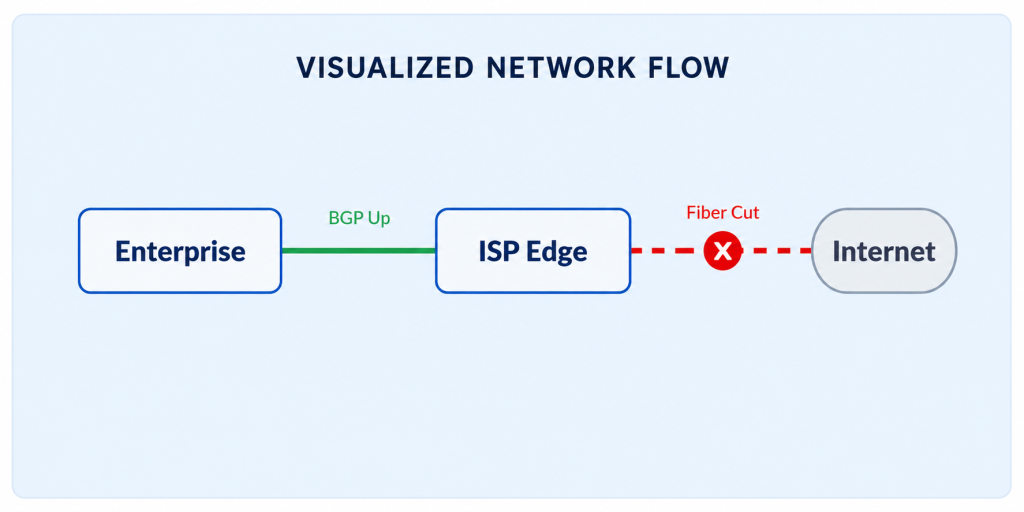
An enterprise connects to a primary Internet Service Provider (ISP) to support its workforce. Using BGP, the enterprise router receives a single default route from the ISP, directing all outbound traffic to that provider.
| The Incident: Employees lose access to all cloud applications. Monitoring shows the physical ISP link is green. The BGP session is established, and the default route is active. The problem? The ISP has suffered a severe fiber cut deep inside their core network. |
| The Business Impact: The enterprise router only sees a healthy local connection and a valid default route. It blindly forwards corporate traffic into the ISP network, where it drops into a black hole. Meanwhile, an expensive backup connection sits idle, halting productivity. |
| The Solution: BGP inherently trusts received routes without tracking end-to-end connectivity. Relying solely on a default route is risky. Instead, engineers request partial routing tables. If the provider loses upstream connectivity, specific routes withdraw dynamically, forcing traffic to the backup ISP. |
Scenario 2: Cloud Private Connection and Internet VPN Backup
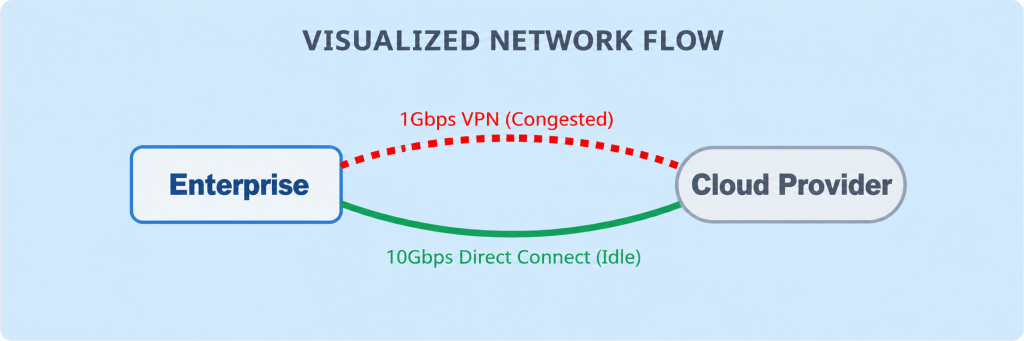
| The Setup: An enterprise migrates critical databases to the cloud. They purchase a dedicated 10-Gigabit connection (like AWS Direct Connect) and establish a 1-Gigabit encrypted internet VPN for redundancy. Both paths use BGP. |
The Incident: During quarter-end processing, the cloud database is extremely slow. Engineers discover the 10-Gigabit link has zero traffic. Instead, all cloud data traverses the slower 1-Gigabit VPN, maxing out capacity and causing packet loss. |
The Business Impact: Database responses are delayed, financial transactions time out, and reporting fails. The business pays thousands for a premium connection that goes unutilized. |
| The Solution: BGP does not automatically prefer a faster physical cable; it relies on route attributes. The cloud provider sent traffic back over the VPN because the BGP path looked equally valid. Enterprises must manipulate attributes to enforce traffic engineering. By applying a higher Local Preference on the enterprise side, outbound traffic is forced over the dedicated link. To fix inbound traffic, engineers use AS-Path prepending on the VPN route, making the VPN path artificially longer to the cloud provider, ensuring the private connection is prioritized. |
Scenario 3: Asymmetric Routing Through Two Firewalls
| The Setup: A highly secure enterprise operates two data centers, each with a dedicated edge firewall and internet connection. BGP advertises the company’s public IP addresses out of both locations simultaneously. |
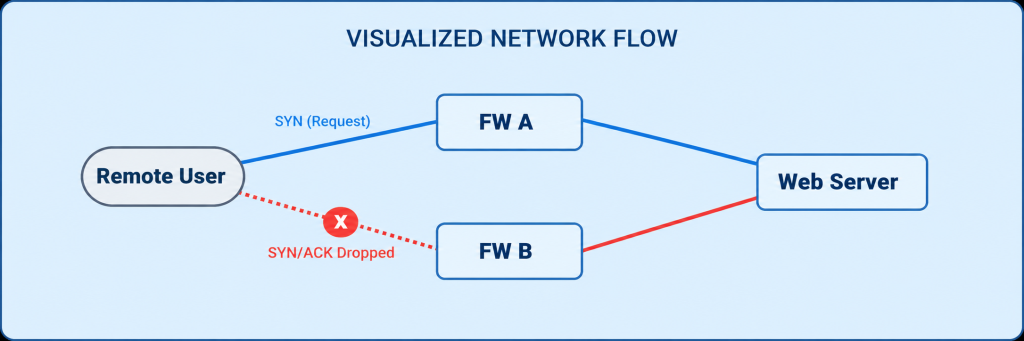
| The Incident: A remote employee attempts to connect to an internal web portal. The initial request reaches the server, but the connection hangs. Server logs show it is responding, but the user receives nothing. |
| The Business Impact: Remote workers cannot access essential corporate resources. The issue is deeply confusing because internal tests work perfectly, but external connections fail silently. |
| The Solution: This is an asymmetric routing problem caused by BGP and stateful firewalls. The remote user’s traffic was routed to Data Center A. The web server processed the request, but the internal routing table pointed to Data Center B as the quickest path out. Data Center B’s firewall intercepted the outbound traffic. Because it never saw the initial incoming request, it flagged the response as a security violation and dropped the packets. To resolve this, network teams tune BGP Multi-Exit Discriminator (MED) values to guarantee that traffic entering a specific data center is forced to exit through that same location. |
Scenario 4: Uneven Customer Traffic across Two Data Centers
| The Setup: A global e-commerce enterprise operates two active data centers in New York and London. They use BGP Anycast, advertising the same public IP block from both locations, relying on the internet to route customers to the closest facility. |
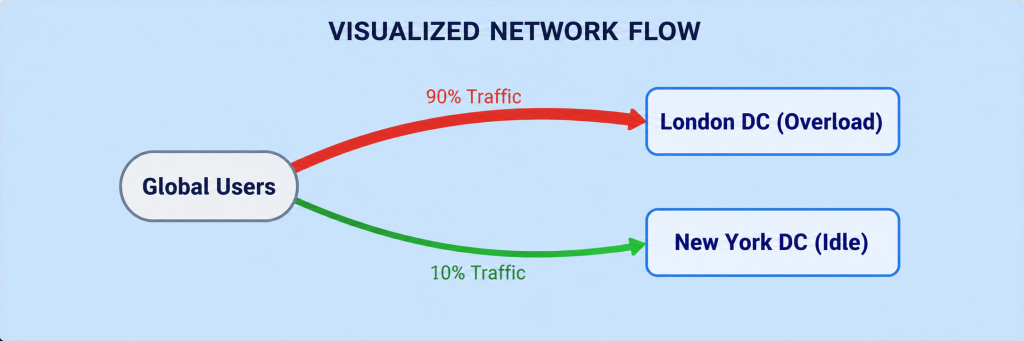
| The Incident: During a massive holiday sale, the London data center crashes. Monitoring reveals an alarming imbalance: 90% of global customers, including those in North America, are routed to London, while New York sits idle. |
| The Business Impact: The website crashes for European users due to server overload. North American users experience terrible latency because their traffic unnecessarily crosses the Atlantic. Holiday revenue drops significantly. |
| The Solution: In BGP Anycast, “closest” means the shortest AS-Path, not geographic distance. If London connects to a massive Tier-1 global provider and New York connects to a smaller regional provider, the internet views London as closer. To rebalance the load, enterprise engineers use BGP AS-Path prepending at the London site. By artificially inflating the route length broadcast from London, they successfully push North American traffic back toward the New York data center, stabilizing the application delivery. |
Scenario 5: Primary and Disaster-Recovery Service Flow
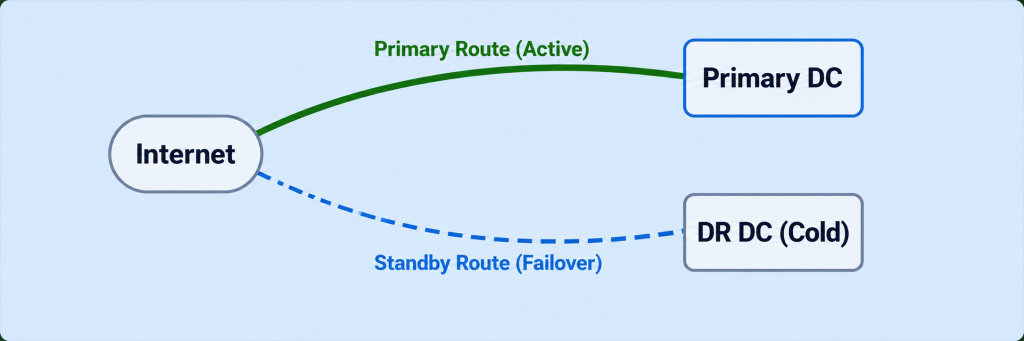
| The Setup: A healthcare organization stores patient records in a primary data center and maintains a Disaster Recovery (DR) facility as a cold standby. Both sites connect to the internet using BGP. |
| The Incident: Security alerts indicate live patient traffic is randomly hitting the DR facility. Because the DR database is synced daily, users accidentally routed there see outdated medical records or application errors. |
| The Business Impact: Medical professionals cannot access up-to-date patient histories, creating severe clinical risks. IT is forced to manually shut down the DR connections to stop the bleeding. |
| The Solution: The enterprise mistakenly advertised the same IP prefixes from both locations with equal BGP attributes. The unpredictable internet decided the DR site was the best path for some users. To maintain an active/standby architecture, enterprises advertise a large, less specific block (like a /23) from the DR site, while advertising smaller, more specific blocks (like two /24s) from the primary site. The internet always prefers the most specific route, guaranteeing zero traffic reaches the DR site until the primary site stops advertising. |
Scenario 6: The Accidental Enterprise Route Leak
| The Setup: A growing enterprise brings in a second major ISP to increase bandwidth. The enterprise router peers with both ISP A and ISP B via BGP, receiving global internet routing tables to make outbound path decisions. |
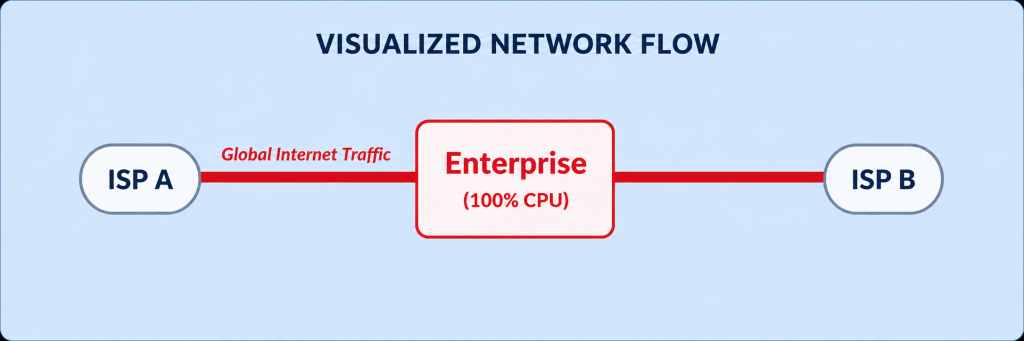
| The Incident: Immediately after bringing the second ISP online, the enterprise network collapses. The edge router’s CPU spikes to 100%, and the physical links to both ISPs become completely saturated with unknown internet traffic. |
| The Business Impact: Digital infrastructure is paralyzed. Warehouses cannot process shipments, and the website goes offline. The business accidentally became a transit provider for the global internet. |
| The Solution: This is the infamous BGP route leak. The enterprise router learned routes from ISP A and incorrectly re-advertised them to ISP B. Because the enterprise looked like a valid path, ISP B started sending global transit traffic through the enterprise’s small router. To prevent this, engineers must configure strict BGP route filtering. By applying prefix-lists and AS-Path filters on outbound updates, the enterprise ensures it only advertises its own internal IPs, blocking external routes from leaking. |
Scenario 7: DDoS Traffic Dropped Inside the ISP Network
| The Setup: A financial services firm relies on a clean, low-latency 10-Gigabit internet connection for high-frequency trading. They manage their own BGP routing and rely on a high-end firewall to filter malicious traffic. |
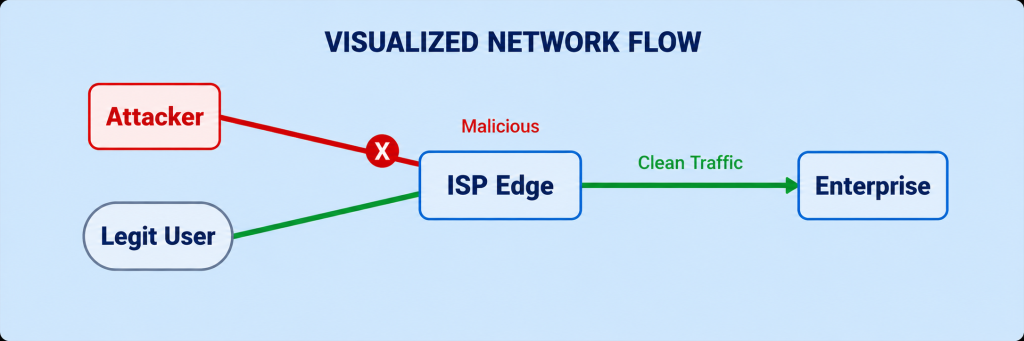
| The Incident: A massive Distributed Denial of Service (DDoS) attack hits the firm’s trading server at 40 Gigabits per second. Although the enterprise firewall identifies and drops the malicious packets, the physical internet pipe is entirely choked upstream. |
| The Business Impact: Legitimate trading traffic cannot enter or leave. The firm loses millions in potential trades. The on-premises firewall is utterly useless because the congestion happens before traffic reaches the building. |
| The Solution: The enterprise uses a BGP feature called Remotely Triggered Black Hole (RTBH). Through BGP, the enterprise sends a highly specific route update (a /32 for the targeted server) to their ISP, tagged with a special BGP Community string. When the ISP’s core routers see this community, they immediately drop all traffic destined for that server at the ISP edge. This sacrifices the targeted server but instantly clears the 10-Gigabit pipe, allowing legitimate trading to resume. |
Scenario 8: Merger between Two Enterprise Networks
| The Setup: A manufacturing enterprise acquires a competitor. Both manage their own networks using BGP. As they integrate, they physically connect their two primary data centers over a private fiber link. |
| The Incident: When engineers attempt to bring up the BGP session across the new link, the connection fails. Even when the session establishes, neither side accepts the other’s routing updates, preventing traffic flow. |
| The Business Impact: Integration is heavily delayed. Employees from the acquiring company cannot access the newly purchased company’s internal applications, stalling collaboration, payroll, and resource sharing |
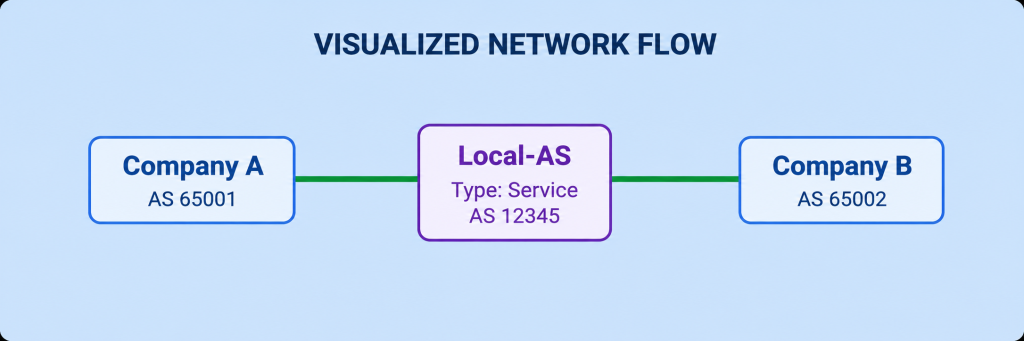
| The Solution: The issue stems from a common enterprise oversight: both companies use the same private BGP Autonomous System Number (ASN), such as AS 65000. In BGP, if a router sees its own ASN in the AS-Path of an incoming route, it assumes a routing loop and drops the route. Reconfiguring thousands of routers to change the ASN is an operational nightmare. Instead, engineers use BGP Local-AS. This allows one edge router to spoof a different, temporary ASN exclusively for the peering session, successfully bypassing the loop prevention mechanism. |
Scenario 9: BGP Next Hop Dependent on an Unstable IGP Path
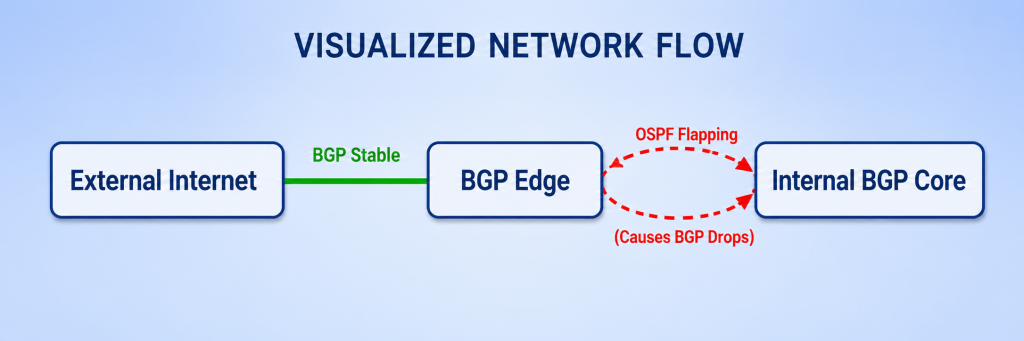
| The Setup: An enterprise utilizes external BGP for internet routing, while an internal protocol like OSPF connects the campus network—the edge BGP router peers with another internal BGP router located deeper inside the headquarters. |
| The Incident: The external internet connection is perfectly stable, yet internal users complain of intermittent internet drops every few minutes. The BGP sessions remain established, but the routing table constantly resets. |
| The Business Impact: VoIP calls drop mid-sentence, virtual meetings disconnect, and critical file transfers fail. The network is fundamentally untrustworthy, crippling day-to-day operations and frustrating external customers. |
| The Solution: BGP is highly dependent on the underlying internal network. When BGP learns a route, it must resolve the Next Hop IP address. It relies on OSPF to physically reach that Next Hop. In this scenario, a failing fiber optic cable caused OSPF to flap rapidly. Every time OSPF flapped, BGP lost its path to the Next Hop and withdrew global routes. Engineers resolve this by stabilizing the OSPF network, summarizing internal routes, and implementing BGP Next-Hop-Self on edge routers to isolate external internet routing from minor internal topology changes |
Conclusion: BGP as a Business Enabler
In the enterprise environment, Border Gateway Protocol is far more than just a set of routing rules; it is a critical business enabler. As demonstrated through these real-world scenarios, BGP is heavily intertwined with security, cloud economics, disaster recovery, and global application performance.
When enterprise networks experience outages, the root cause is rarely a fundamental failure of the BGP protocol itself. Instead, issues arise from how the protocol is applied to complex, multi-layered business topologies. BGP does exactly what it is told- sometimes with devastating efficiency, as seen in accidental route leaks or unoptimized cloud backups.
For network engineers and enterprise infrastructure teams, mastering BGP means looking beyond the command line. It requires a deep understanding of how routing decisions impact application flow, user experience, and overall business continuity. By anticipating how BGP behaves in complex operational scenarios, organizations can build robust, self-healing networks that can withstand the chaotic reality of modern enterprise IT.
Check 100% Job Guarantee Courses
- CCIE Enterprise Infrastructure V1.0/R&S Training in India
- CCIE Security V6.1 Course
- Cyber Security & Network Security Course
- Cloud Security + Network Security Expert
Frequently Asked Questions!
BGP (Border Gateway Protocol) is the Internet’s routing protocol. It allows different autonomous systems such as ISPs, cloud providers, and large enterprises to exchange routing information and determine the best path for IP traffic. Unlike IGPs such as OSPF or EIGRP, which route traffic within a single organization, BGP is designed to route traffic between different organizations. As enterprise networks grow, they often connect to multiple external networks. BGP provides the scalability, flexibility, and control needed to manage those connections.
The protocol is commonly used for advertising prefixes to several ISPs, using characteristics such as LOCAL_PREF for traffic manipulation and the use of route reflectors. E-commerce companies employ BGP for the purposes of failover when traffic peaks, whereas banks utilize it for secure and low-latency traffic.
BGP implementations can face several challenges, including neighbor session failures, route flapping, incorrect route advertisements, and routing policy misconfigurations. Problems such as next-hop reachability issues, route leaks, or unstable underlying IGPs like OSPF or IS-IS can also disrupt BGP operation and lead to traffic outages. In large networks, excessive routing updates or full Internet routing tables may increase CPU and memory utilization, affecting router performance. Proper design, route filtering, policy control, and continuous monitoring are essential to maintain a stable and reliable BGP deployment.
A successful BGP implementation follows best practices such as using a hierarchical network design, implementing route filtering with prefix lists and route maps, and applying routing policies to control traffic flow. Enterprises should use authentication for BGP neighbor sessions, enable maximum-prefix limits to prevent excessive route advertisements, and ensure reliable IGP connectivity for BGP next-hop reachability. Redundant BGP peers, proper timer configuration, and continuous monitoring of BGP sessions help improve network resilience and minimize downtime.