
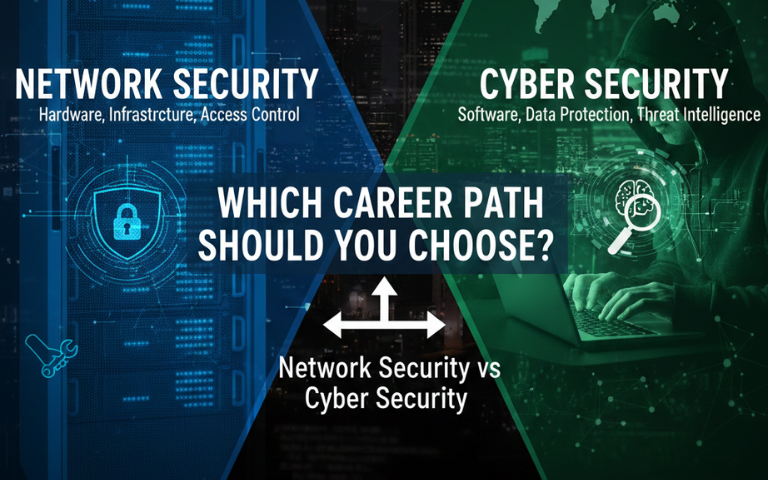
Discover the differences between cybersecurity and network security to decide your perfect career path in digital defense. Choose wisely and kick-start your IT journey today.
In a world where technology is everywhere, the need for tech-savvy professionals is going up very fast. According to the Bureau of Labor Statistics (BLS), the number of computer and information technology jobs will grow significantly during the next ten years.
The rising demand, in general, is due to technology becoming more and more a part of healthcare, the need for cloud computing having no limits, and data security being very important for businesses.
What are cybersecurity and network security?
Both fields are essential security components that belong to the broader concept of information security, which is the general goal of protecting the system from illegal access and breaches.
We compare cybersecurity vs. network security to figure out their different functions in the online world.
Is Network Security the Same as Cybersecurity?
When considering the difference between network security and cybersecurity, one might easily think that they are identical.
While both areas aim to preserve the security of the physical part, information systems, and electronic data, they are operating in different fields.
Network security is basically a matter of protecting data while it is being transferred via networks, thus making sure it is not stolen or otherwise misused via security breaches that cause the loss of data, sabotage, or unauthorized access.
Unlike that, cybersecurity, as the name suggests, is a “big picture” concept. It concentrates on finding and eliminating security loopholes in the code as well as in the organization’s infrastructure.
What Is Cybersecurity?
Cybersecurity is about securing a computer’s internet, network, and applications against security threats. To wit, cybersecurity experts are the digital defenders who repel external assaults and security breaches that might happen internally.
They are in charge of checking both the traffic that comes and goes and the security measures that an organization takes. Besides this, they are on a constant lookout for system weaknesses, illegal electronic access, and intruders.
One major threat to cybersecurity is social engineering, which depicts situations where the perpetrators use various tricks to influence people and thus gain access to sensitive information.
Phishing emails, for instance, are in this category alongside CDs or USBs loaded with viruses, and malware that is designed to damage the users.
Why You Need Cybersecurity
Cybersecurity is not just an option; it is a must in the present digital world. The main reasons are:
Protection of Sensitive Data: Cybersecurity defends confidential user data such as financial information and passwords by encrypting them from hackers and online criminals. The use of reliable internet security tools like firewalls, antivirus programs, and VPNs is the way to data security.
Preventing Identity Theft: Once identities are stolen, the criminals behind cyber-attacks use them to carry out different types of fraud, e.g., committing bank fraud and laundering money. Strong cyber security systems provide the necessary security to avoid this scenario.
What Is Network Security?
Network security, the part of a bigger picture of cybersecurity, is stricter in terms of the data focus. It deals with information that is sent over the networks; therefore, it is about the security of the data, its being uncorrupted, and the prevention of hacking or intrusion.
Network security workers are the ones who look after an organization’s IT structure. To be able to detect and eliminate security threats they prepare and keep running the hardware as well as the software.
The main tools used by network security experts to protect an enterprise from cyber threats are firewalls, antivirus applications, and virtual integrating networks (VPN). Their deterrent strategy is to ensure the security of the network by sealing off the attack routes.
Why You Need Network Security
There are countless reasons why network security cannot be dispensed with:
Data Protection: The aim of network security is to prevent illicit access to confidential data like passwords, bank details, and credit card information. It is the security that is always on the lookout for illegal attempts that are not noticed by the users.
Defense Against Phishing: The accounts of the victims of phishing scams, the commonest are the murders, are likely to experience money losses as well as data leaking. The network security system significantly strengthens the resistance of an organization to this kind of intrusion.
Cybersecurity vs. Network Security: In-Depth Comparison
| Aspect | Cybersecurity | Network Security |
| 1. Definition | Safeguards the full digital assets of an organization, including networks, endpoints, applications, cloud environments, and data from cyber threats. | Secures the networking infrastructure ensuring data passes safely through routers, switches, and access points. |
| 2. Scope | Broad coverage encompassing the entire digital ecosystem. This includes user devices, software, operating systems, and internet-facing systems. | Focuses on the security of the physical and virtual pathways that data travels through and is limited to network-related assets. |
| 3. Primary Focus | Safeguards information, devices, applications, and user behavior from exploitation or unauthorized access | Secures infrastructure and data in transit, protecting the organization links through network-based exploits |
| 4. Hierarchy | A subfield of Information Security focused only on digital (cyber) assets and threats. | A subset of cybersecurity focused exclusively on network-level defense |
| 5. Data Protection | Secures data at rest from databases, servers, cloud, and endpoints | Protects data in transit while flowing across their network, both internally and externally. |
| 6. Attack Vectors | Malware, phishing, ransomware, SQL injection, DNS tunneling, zero-day exploits, social engineering | Denial-of-service (DoS/DDoS), man-in-the-middle (MitM) attacks, spoofing, ARP poisoning, unauthorized access |
| 7. Tools and Technologies | Antivirus software, encryption, EDR, SIEM, IAM, AI-driven threat detection, cloud workload protection | Firewalls, VPNs, IDS/IPS, ACLs, VLANs, NAC |
| 8. Threat Sources | External and internal factors: hackers, rogue insiders, social engineers, malicious code | Primarily external threats and faulty configurations affecting connectivity and access control |
| 9. Security Approach | Preventive, detective, and corrective across all endpoints and applications | Preventive and detective, primarily designed to block and alert unauthorized access attempts |
| 10. Responsibilities | Safeguard the overall architecture of the system, maintain compliance (HIPAA, GDPR, PCI), and review user activity and data management | Ensure a secure network architecture, observe traffic and access to devices and respond to the incidents of the network |
| 11. Roles and Job Titles | Cyber Security Analyst, Cyber Security Architect, SOC Analyst, Incident Responder, Threat Intelligence Analyst | Network Security Engineer, Network Architect, Firewall Administrator, Network Security Analyst |
| 12. End Goal | Safeguard confidentiality, integrity, and availability of all digital assets both on-premise and cloud. | Safeguard and allow secure flow of data, and protect the infrastructure of digital operations. |
Educational Requirements
The fields of cybersecurity and network security are pretty much the same and both require a large variety of skills. You can still learn networking and cybersecurity even if you come from any of these areas, Science, Commerce, Arts, or any other.
Although generally it is assumed that the first step would be a bachelor’s degree in computer science or engineering, students from various academic backgrounds are taking this route to the field by means of diploma courses, certifications, online programs, and specialised degrees in cybersecurity.
Both the fields can benefit from a certification like Certified Information Systems Security Professional (CISSP).
Certifications for Cybersecurity and Network Security
In both cyber and network security, certificates are an integral part of a professional’s folder.
Some of the cybersecurity certifications are CISSP, CSA, CISM, Security+, CEH, GSEC, SSCP, and CASP. The network security credentials are as important as the cybersecurity ones and can open up further career opportunities for you.
Pros and Cons
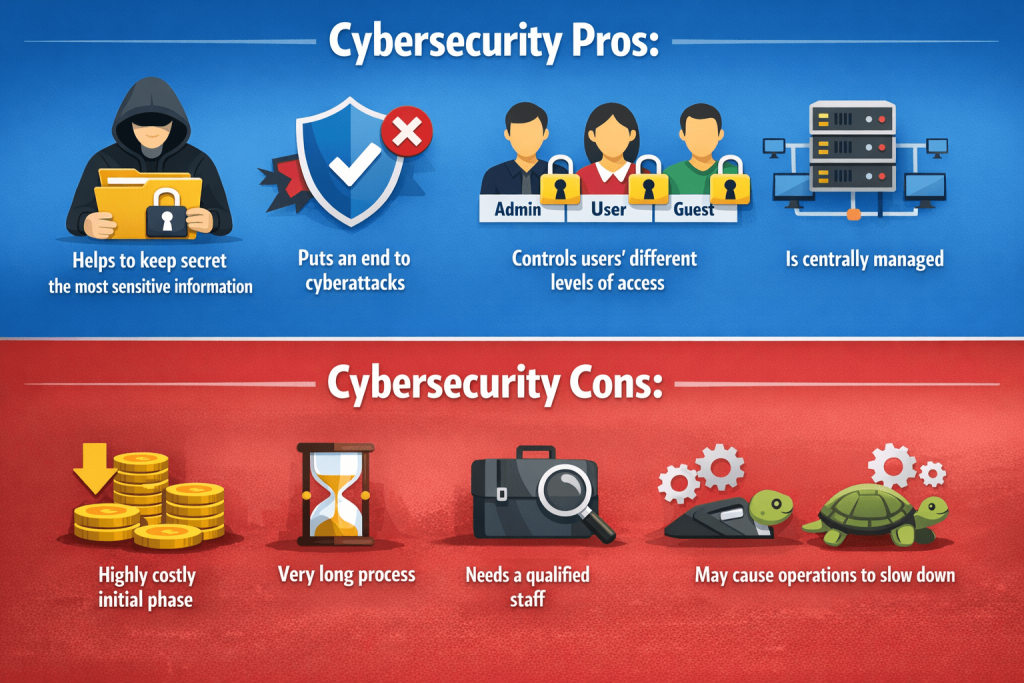
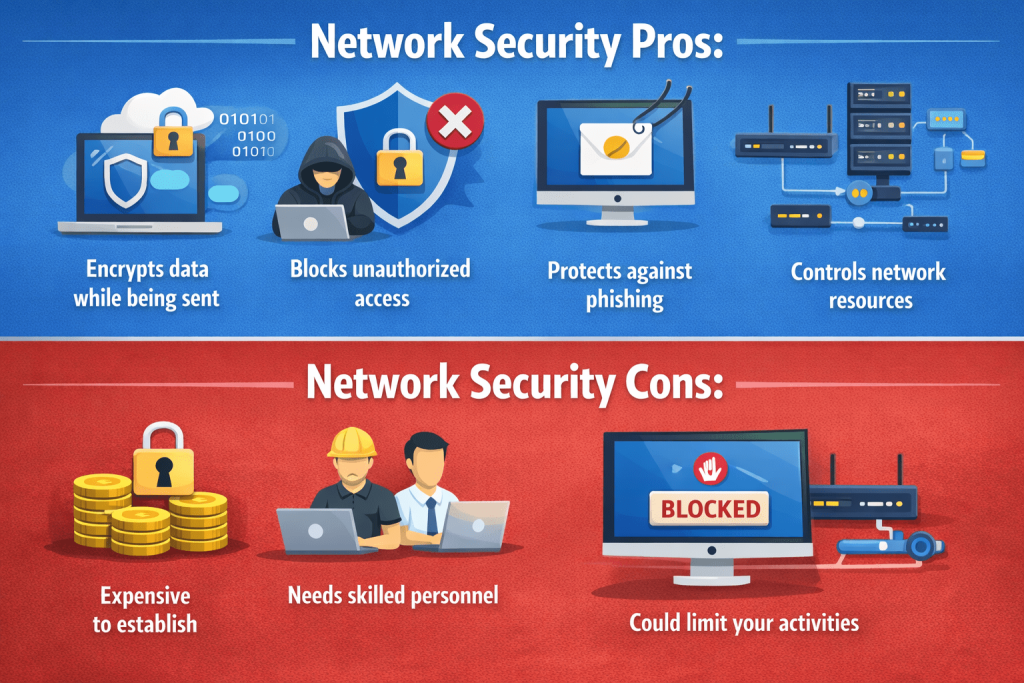
Which advantages and disadvantages do each technological field have:
Choosing Your Path: Cybersecurity or Network Security in the Digital Age
Without both cybersecurity and network security, the digital age would simply not be possible. While they have the same end goal – protecting data – they differ in their methods and areas of focus.
Cybersecurity involves the protection of systems, devices, and digital resources from unauthorized access, whereas network security is all about keeping the data safe when it is being transferred via networks. The decision between these two positions is up to your inclinations, the kind of work you imagine doing, and the abilities you want to develop.
Network Bulls is among the best academies that delivers a complete training program in both areas, thus enabling students to gain an industry-oriented learning experience, have excellent career prospects, and get remarkable networking opportunities to help them succeed in the tech domain.
Whichever road you take, these two sectors will not only be your strong weapons but also your leaders in the continuously changing digital world where there are always new challenges and developments.
Final Thoughts!
You have to realize that cybersecurity and network security are different things, not the same, and they are different groups working against digital threats. Basically, network security is the security of the system, it is the first line of defense that keeps the attackers away.
Cybersecurity, however, is a cover that includes everything, it is the protection of the data, devices, apps, and users in the entire digital ecosystem. If you are totally committed to the security of sensitive information and ensuring that the system is safe, then you have to have both.
It is not a question of either one, the key to today’s extremely sophisticated threats is figuring out how they work together to repel them.