Introduction: The changing landscape of Enterprise Networks
For decades, enterprise networks relied on a fundamental building block to keep traffic separated and organized: the Virtual Local Area Network, commonly known as the VLAN. When networks were primarily composed of physical desktop computers, local servers, and wired printers, VLANs were an ideal solution. It allowed network administrators to divide a single physical switch into multiple logical networks, ensuring that accounting data did not mix with engineering data. It was simple, effective, and universally understood by engineers around the world.
However, the technology landscape has shifted dramatically over the past fifteen years. Today’s enterprise environments are no longer confined to static hardware or single office buildings.
We live in an era defined by massive enterprise data centers, cloud computing, server virtualization, and the Internet of Things (IoT). A single physical server now hosts dozens or even hundreds of virtual machines. These virtual machines frequently need to migrate from one physical server to another for load balancing, power management, or hardware maintenance without losing their network connection or changing their assigned IP addresses.
Furthermore,
| The modern enterprise operates on |
|---|
| >A staggering scale >Large corporations >Universities >Hospitals >Global service providers host tens or hundreds of thousands of connected devices. |
They require strict security policies and the ability to isolate different types of traffic on a massive scale. As these demands grew exponentially, network engineers quickly discovered that the traditional VLAN was beginning to show its age. The tools that worked brilliantly in a small office building were suddenly breaking under the immense pressure of dynamic, modern data centers and expansive campus networks.
To understand why a new architectural solution was necessary, we must first examine the inherent limitations of traditional VLAN architecture. Only by understanding the specific pain points experienced by enterprise infrastructure teams can we truly appreciate the elegance and power of the solution that emerged to replace and extend it: the Virtual Extensible Local Area Network, or VXLAN.

Why traditional VLANs hit a wall
The traditional VLAN is defined by an industry standard known as IEEE 802.1Q. This standard adds a small piece of information (a tag) to every packet of data traveling across the network wire. This tag identifies which VLAN the packet belongs to. While this system is ingenious for its time, it has a critical architectural flaw that severely limits its usefulness in enterprise environments: the absolute size of the 802.1Q encapsulation.
The 4,094 Segment Limit
The VLAN tag is exactly 12 bits long in binary format. In mathematics, a 12-bit number can represent a maximum of 4,096 unique values. Since VLAN 0 and VLAN 4095 are reserved for system and management purposes, network engineers are left with precisely 4,094 usable VLANs. In the 1990s, the idea of a single company needing more than four thousand distinct network segments seemed virtually impossible. Today, in environments where multiple business units or external customers share the same physical data center infrastructure (a concept known as multi-tenancy) or where every IoT device category requires its own isolated security zone, 4,094 segments are simply not enough. Service providers and large enterprises frequently run out of VLANs, forcing them into complex and difficult-to-manage workarounds.
The Spanning Tree Protocol (STP) Bottleneck
Beyond the strict numerical limit, VLANs suffer from severe architectural constraints when it comes to high availability and network resilience. In any robust enterprise network, creating multiple physical paths between switches is essential. If a fiber cable is cut or a switch card fails, the data must have an immediate alternative route. However, multiple parallel paths in a Layer 2 network create loops. Data packets circulate endlessly, multiplying in number until they consume all available bandwidth and bring the entire network to a standstill- a catastrophic event known as a broadcast storm.
To prevent these loops, traditional networks rely heavily on the Spanning Tree Protocol (STP). STP acts as an automated traffic cop, actively blocking redundant backup paths to ensure that only a single active route exists between any two points. While STP successfully prevents loops, it is incredibly inefficient. In a highly redundant network where an enterprise has paid for multiple high-speed links, STP forces half of that expensive capacity to sit idle, completely unused. Furthermore, when an active link fails, STP can take several seconds to recalculate and unblock a backup link, causing noticeable application disruptions.
Massive MAC Address Tables and Flooding
Another major challenge in traditional Layer 2 networks is how switches learn where devices are located across the topology. A network switch builds a map (called a MAC address table) by watching the source traffic that flows through its ports. If a network stretches across an entire massive campus or multi-building facility, every switch in that Layer 2 domain might need to learn the MAC address of every single connected device. In a modern data center with hundreds of thousands of virtual machines, the memory required to store these addresses quickly exhausts the physical capabilities of enterprise switches, leading to dropped packets, high CPU utilization, and severe performance degradation.
Enter VXLAN: A simple explanation of a Powerful idea
To solve the fundamental limitations of traditional VLANs, the networking industry needed a completely new approach. They needed a way to provide more than 4,094 segments, utilize all available network links without relying on idle STP blocking, and prevent every switch from having to memorize every device’s MAC address. The answer to these challenges was VXLAN.
| VXLAN stands for Virtual eXtensible Local Area Network. At its foundational core, VXLAN is an overlay technology. To understand this clearly, imagine the physical network of cables, routers, and switches as a system of major highways connecting different cities. This physical network is called the Underlay. Its sole job is to move traffic from one location to another as quickly, reliably, and efficiently as possible, using standard Internet Protocol (IP) routing. |
VXLAN creates a logical, virtual network that rides on top of these physical highways. This virtual network is called the Overlay.
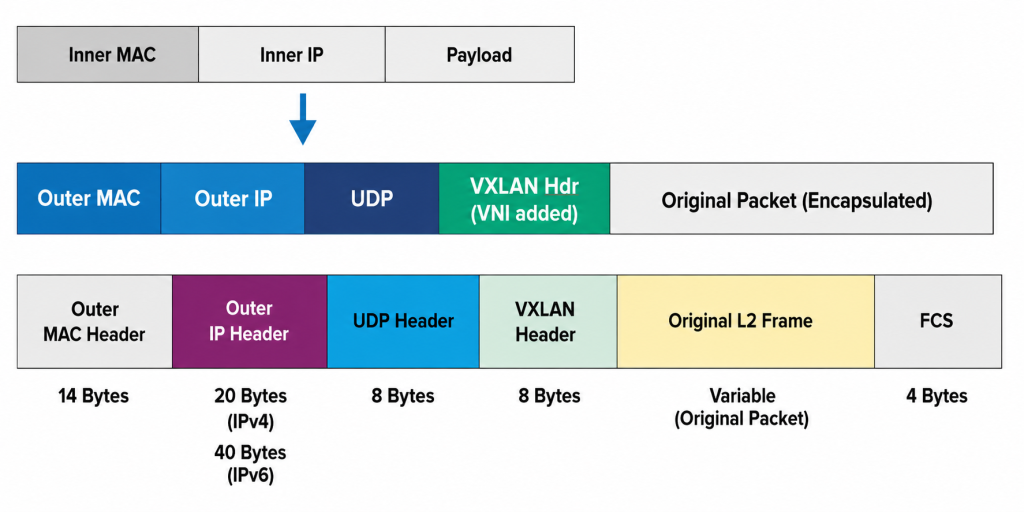
When a machine sends a standard Layer 2 packet, the VXLAN system takes that entire packet, places it inside a completely new transport envelope (specifically a UDP packet), and mails it across the IP underlay highway. When the packet reaches the destination edge, the outer envelope is stripped away, and the original Layer 2 packet is delivered untouched.
This encapsulation process is known as MAC-in-UDP encapsulation. By hiding the original Layer 2 packet inside a routed IP packet, VXLAN achieves something remarkable: it tricks the network into extending a single local network across massive geographic distances and complex routed infrastructures, without any of the inherent risks associated with stretching traditional VLANs.
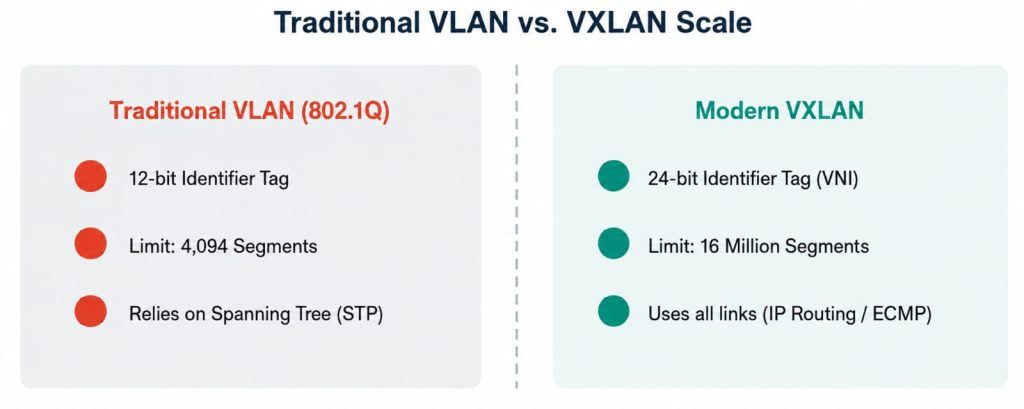
| The VXLAN Network Identifier (VNI) To permanently address the 4,094 segment ceiling, VXLAN introduces a much larger tag called the VXLAN Network Identifier (VNI). The VNI is a 24-bit field. In binary mathematics, 24 bits allow for over 16 million unique segment identifiers. Suddenly, the problem of running out of network segments is completely eliminated. An enterprise can create a unique, isolated network for every single application, every tenant, or every department without ever worrying about exhausting their pool of identifiers. |
Real-World Enterprise scenario 1:
The Multi-Tenant Data Center
Let us explore a practical scenario where VXLAN is indispensable in enterprise architecture. Consider a large enterprise that operates a private cloud data center. This data center serves multiple distinct divisions within the company: Human Resources, Research & Development, and Finance. Additionally, it might host infrastructure for external partner companies and vendors. This is known as a multi-tenant environment.
In this environment, strict data isolation is critical. The Finance department’s servers must be completely invisible and inaccessible to the partner company’s servers. Furthermore, because these different departments often build their internal applications independently, they frequently use the same private IP address ranges. In a traditional network, connecting two servers with overlapping IP addresses causes catastrophic routing conflicts.
VXLAN solves both the scale and the overlapping IP issues gracefully. Network engineers assign a unique VNI to each tenant. Finance might be assigned VNI 10001, while R&D is assigned VNI 20001. When a server belonging to Finance sends a data packet, the first network switch it encounters (known as the VXLAN Tunnel Endpoint, or VTEP) encapsulates the packet and stamps it with VNI 10001. As this packet travels across the physical data center, the underlying network routers only look at the outer delivery envelope. They do not look at the inner, original packet, and they do not care if the inner IP address overlaps with another department. They deliver the envelope to the correct destination switch. The receiving switch opens the envelope, sees VNI 10001, and knows it can only deliver this packet to another Finance server. This creates complete logical isolation, allowing millions of tenants to securely share the same physical infrastructure, including cables and switches, without conflict.
VXLAN provides a safe, scalable way to stretch Layer 2 domains over a routed Layer3 network, preserving IP addresses for VM mobility while isolating broadcast storms.
Real-World Enterprise scenario 2:
Data Center Interconnect (DCI) and VM Mobility
Another profound challenge in modern enterprise networks is geographic redundancy and workload mobility. Imagine an enterprise with two major data centers: one in New York and a backup facility in New Jersey. For disaster recovery and seamless load balancing purposes, the enterprise utilizes virtual machines (VMs). A powerful feature of virtualization software is the ability to move a running VM from one physical server to another without shutting it down (a process known as live migration).
For live migration to work without disconnecting active users, the VM must keep its exact same IP address and MAC address during the move. Consequently, the new server in New Jersey must reside on the exact same Layer 2 subnet as the old server in New York. Historically, engineers solved this by stretching traditional VLANs across dark fiber links between cities, which is extremely dangerous because any broadcast storm in New York instantly crashes New Jersey.
With VXLAN over routed Layer 3 connections, broadcast storms are stopped at router boundaries. The virtual machine in New York believes it is on the same local network as servers in New Jersey, moving freely between data centers while keeping the underlying physical core stable.
VXLAN Packet Encapsulation (MAC-in-UDP)
The original Layer 2 frame is wrapped inside a new UDP/IP transport envelope
Real-World Enterprise scenario 3:
Campus Networks and IoT Segmentation
While VXLAN was initially adopted in massive data centers, its immense value quickly became apparent to enterprise campus network designers. Consider a modern university campus, a large hospital, or a corporate headquarters. These environments are no longer just populated by laptops and employee smartphones. They are flooded with Internet of Things (IoT) devices: smart thermostats, security cameras, medical imaging machines, badge readers, and automated lighting systems.
These devices present a massive security risk. A compromised smart thermometer should never have network access to the server holding employee payroll data or patient health records. Therefore, micro-segmentation is required. Network security teams must place every category of device into its own strictly isolated virtual network.
Applying traditional VLANs across hundreds of wiring closets to support dozens of different IoT categories results in a fragile, unmanageable mess. Engineers must manually configure VLAN trunks across every switch in the path. If an IP camera is moved from the East Wing to the West Wing, a technician must reconfigure the switches in both locations.
By implementing a VXLAN fabric across the campus, the physical network becomes a simple, high-speed IP transport mechanism. The intelligence is pushed to the edges of the network (the switches connecting directly to the devices). When an IP camera plugs into any port anywhere on the campus, the edge switch recognizes it, instantly assigns it to the “Security Camera VNI,” and encapsulates its traffic. The camera can only communicate with the centralized security servers. The physical location of the camera no longer matters. This enables dynamic policies, effortless mobility for devices, and significantly reduces the manual configuration burden on network teams.
The Brains Behind VXLAN
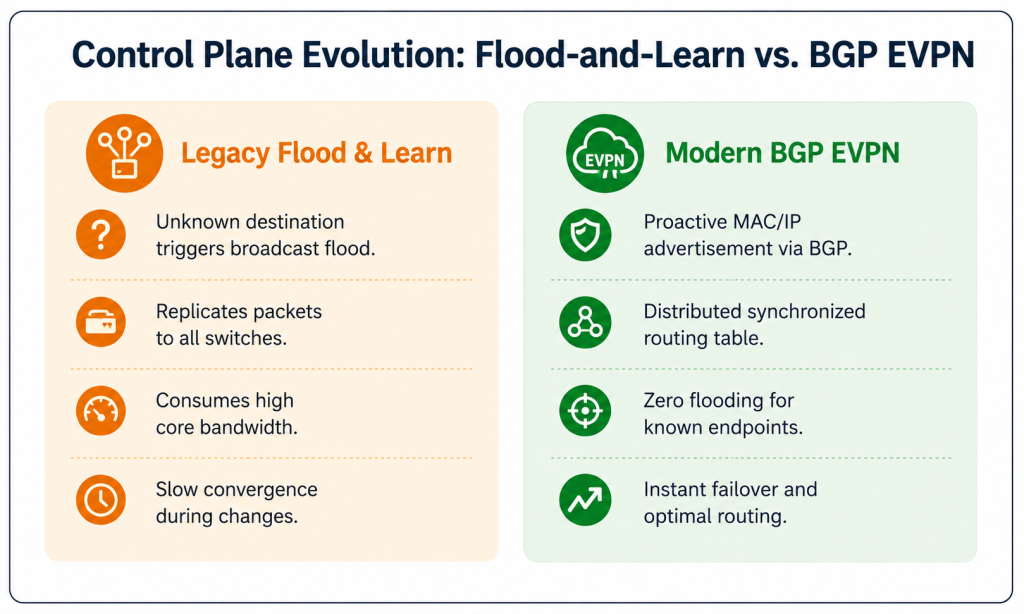
While VXLAN provides the perfect data transport mechanism (the envelope), it initially suffered from a missing piece of logic. In its earliest iterations, VXLAN did not have a smart way to figure out where specific devices were located. If a switch did not know where a specific MAC address lived, it had to copy the packet and flood it out to every single switch in the network, asking, “Does anyone have this device?” This behavior, known as “flood and learn,” is incredibly inefficient and wastes massive amounts of bandwidth in a large enterprise.
To fix this, the networking industry introduced a control plane (a brain) for VXLAN, called Ethernet Virtual Private Network (EVPN). EVPN utilizes a highly stable, industry-standard routing protocol (specifically, an extension of BGP) to share information proactively.
Instead of yelling across the network to find a device, a switch using EVPN quietly observes when a new computer or virtual machine connects to it. It notes the device’s MAC address and IP address. Then, using EVPN, it sends a highly efficient, targeted update to the other switches in the network, saying, “I have this device at my location.” All switches in the enterprise build a precise, synchronized database of exactly where every device is located. When a server needs to send data, its local switch checks this database, instantly knows the destination switch’s IP address, and sends the VXLAN-encapsulated packet directly to the target. There is no guessing, no flooding, and no wasted bandwidth. EVPN elevates VXLAN from a simple encapsulation trick to a highly intelligent, self-routing, enterprise-grade architecture.
Conclusion: Building the Network of the Future
- The traditional VLAN served the technology industry exceptionally well for over two decades. However, the hard limits built into its architecture- the restriction of 4,094 segments, its reliance on inefficient loop-prevention protocols like STP, and its inability to handle massive MAC address tables- rendered it insufficient for the demands of the modern enterprise.
- VXLAN represents a paradigm shift in how we architect networks. By decoupling the logical network from the physical cables- creating an overlay network- enterprises gain unprecedented flexibility. The 24-bit VNI shatters scalability limits, offering over 16 million unique segments for multi-tenancy and IoT micro-segmentation. Encapsulating traffic inside routed IP packets eliminates the dangers of Layer 2 broadcast storms, while technologies like EVPN provide intelligent, flood-free routing.
- Whether it is allowing virtual machines to migrate seamlessly across geographical locations, securely isolating financial data in a shared data center, or managing the explosion of IoT devices on a corporate campus, VXLAN provides the foundation. It is no longer just a specialized tool for cloud giants; VXLAN has become the standard architectural model for any enterprise preparing its infrastructure for the limitless scale of the future.
Check 100% Job Guarantee Courses
- CCIE Enterprise Infrastructure V1.0/R&S Training in India
- CCIE Security V6.1 Course
- Cyber Security & Network Security Course
- Cloud Security + Network Security Expert
Frequently Asked Questions (FAQs)
EVPN provides the control plane for VXLAN by using BGP to advertise MAC and IP
information. This eliminates inefficient flood-and-learn behavior, reduces unnecessary
broadcast traffic, and enables fast, intelligent forwarding decisions.
VXLAN is particularly valuable for multi-tenant data centers, cloud environments, disaster
recovery and data center interconnect (DCI), campus networks, and IoT deployments where
scalability, mobility, and secure network segmentation are essential.
VXLAN operates over a routed Layer 3 underlay where Equal-Cost Multi-Path (ECMP) routing can utilize all available links simultaneously. This removes the need for STP to block redundant links, improving bandwidth utilization and resiliency.
A VTEP is responsible for encapsulating Ethernet frames into VXLAN (MAC-in-UDP) packets before sending them across the IP underlay and decapsulating them at the destination. It acts as the bridge between the overlay and underlay networks.
VXLAN extends Layer 2 connectivity over a Layer 3 infrastructure, allowing virtual machines to migrate between data centers while retaining their IP and MAC addresses. This enables seamless workload mobility without stretching traditional VLANs.
EVPN provides the control plane for VXLAN by using BGP to advertise MAC and IP information. This eliminates inefficient flood-and-learn behavior, reduces unnecessary broadcast traffic, and enables fast, intelligent forwarding decisions.
VXLAN is particularly valuable for multi-tenant data centers, cloud environments, disaster recovery and data center interconnect (DCI), campus networks, and IoT deployments where scalability, mobility, and secure network segmentation are essential.